Hitoyoshi is my top 3 hardest places to get to. It’s located deep in Kumamoto Prefecture, but I noticed on the map that it’s surprisingly close to Kagoshima Airport.
hitoyoshi station garage
hitoyoshi station closed due to disaster
hitoyosshi kaname fall4 chestnut bento in front of fall
First, I went to Hitoyoshi Station from the airport and bought the famous chestnut bento (lunch box). Even the shape of the bento is chestnut. Before the flood, the old-fashioned ekiben vendors on the platform used to shout out their good-old cries. Now, I pass by the deserted station building and buy a bento at the bento shop next to the station building. With a bento in hand, I head to Kaname Falls (Ohdaki), a waterfall that tumbles vertically down a columnar jointed wall, and eat my lunch while being showered with the spray from the falls. Although the Medaki waterfall is nearby, it is impossible to get any closer due to the large stones and timber that were washed away by the flood. This shows the extent of the damage caused by the flood.
hitoyoshi kaname fall2suiranro1 flood water level
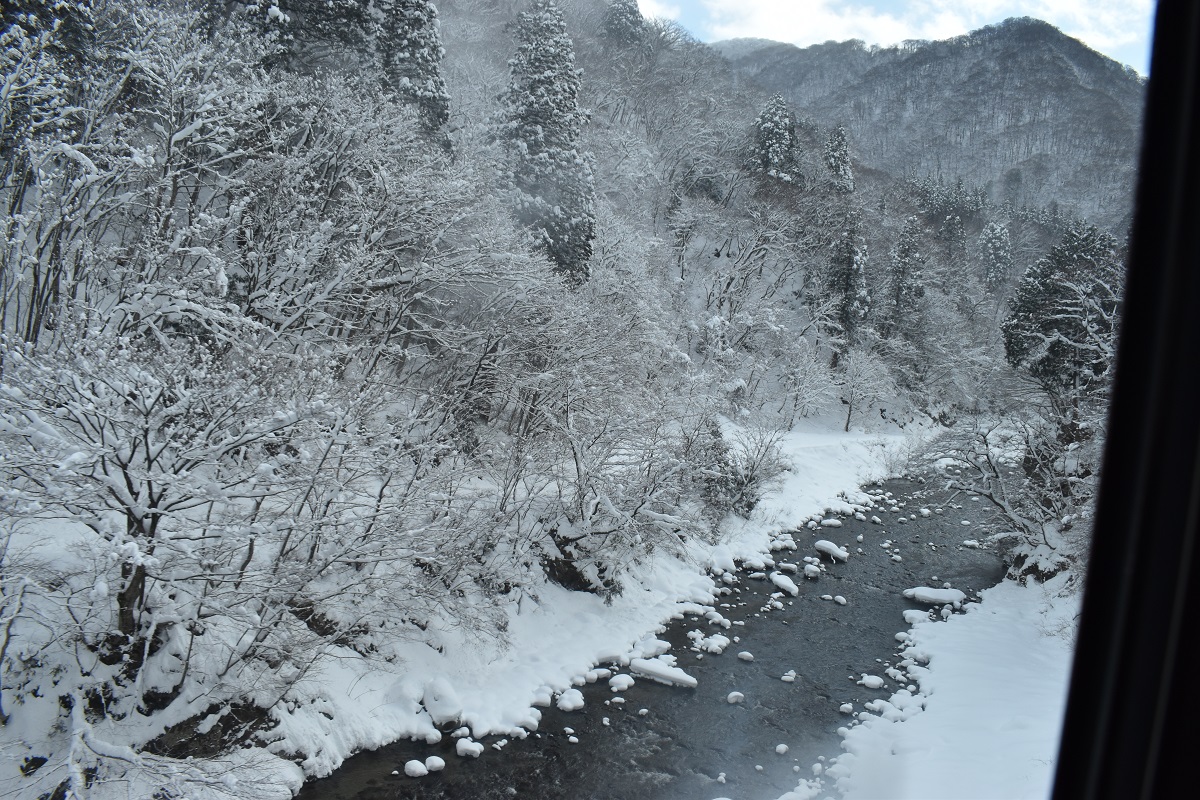
At the hotelwhere I’m staying tonight, there is a marking near the ceiling of the front desk showing the water level of the Kuma River when it overflowed. Apparently, the flood caused driftwood from nearby areas to flow into the Kuma River, where it became caught on railway bridges and other bridges, causing the muddy waters to overflow and wash away the entire town. Now, the Kuma River flows calmly and steadily in front of the hotel.
suiranro2
kuma river3
suiranro3 dinner
suiranro4
suiranro5
suiranro6
suiranro7 in memory of steam locomotive
suiranro8
suiranro9
suiranro11 sweetfishes
suiranro12 tempura
suiranro13
suiranro14
suiranro15
suiranro16
suiranro18
suiranro17
suiranro19
suiranro20 bonito flakes
suiranro21
Aoi Aso Shrine is a national treasure that has managed to survive under such circumstances, and it is definitely worth visiting. The shrine’s sanctuary is generally not open to the public, but an elderly man who seemed to be the chairman of the preservation society, who was watching over the restoration work around the shrine, invited me to see the sanctuary. There is a pamphlet with beautiful color prints, which is free of charge. What is amazing is the 400-year-old building, the thatched roofs of the tower gate and worship hall, the colorful decorations and colors of the Momoyama style, and the intricate plaster decorations of the inner sanctuary. It has an overwhelming presence.
aoiaso shrine15
aoiaso shrine1
aoiaso shrine2
aoiaso shrine4 hengaku
aoiaso shrine5 demon
aoiaso shrine11
aoiaso shrine12
aoiaso shrine6 inside
aoiaso shrine7 inside
aoiaso shrine8 inside
aoiaso shrine9 up and down dragons
aoiaso shrine10 protected by lions
Detour
eikoku temple5 ghost legend
During the Satsuma Rebellion, Takamori Saigo’s troops traveled around the country fighting the Meiji government forces, and here in Hitoyoshi, they had their headquarters at Eikokuji Temple. This place is also known as the Ghost Temple, and a hanging scroll of a ghost has survived the ravages of war without being burned. I found it interesting to read a piece about what one would say if someone came to take them from the afterlife. There are many other attractive temples and shrines remaining in the Hitoyoshi Basin. As the area has been ruled by the Sagara clan since the Kamakura period, it seems that many things of great historical value remain.
eikoku temple7 if someone comes to pick you up from the other world
eikoku temple1 saigo army headquqrter
eikoku temple2
eikoku temple3
eikoku temple4 ghost in the pond
eikoku temple6 cannonball
brewery3
Near Eikokuji Temple is Hitoyoshi Castle, famous for its cherry blossoms, and the famous rice shochu brewery Sengetsu, which you are welcome to come and sample the drinks. The shochu “Kawabe,” which can only be purchased locally, uses water from the clear Kawabe River, which flows into the Kuma River, but recently there has been talk of building a dam to prevent flooding, which worries me.
Shimabara Peninsula was the first place in Japan to be certified as a UNESCO Global Geopark. The peninsula is still pulled north and south, causing the earth in the middle to split apart and become a fault, making it easier for heat sources to rise up. This is the Unzen volcano. In 1991, Mount Unzen erupted, causing a large pyroclastic flow to flow from the mountain into the sea. This was the first time that the term “pyroclastic flow” was recognized in Japan, bringing with it terrifying memories.
chijiiwa fault (1)
The faults allow three different hot springs (Obama Onsen, Unzen Onsen, Shimabara Onsen) to bubble up, and spring water also bubbles up. In Obama Onsen, steam erupting from the earth can be used to make steamed dishes, just like in Beppu Onsen. Unzen Onsen was a summer resort where Westerners came to enjoy vacations to escape the summer heat of Shanghai and Nanjing during the time China was under colonial rule. Shimabara is famous as the place where the people suffering under oppression fought against the Tokugawa shogunate by not hidding Christian faith; after this, their descendants hid their faith throughout the long Edo period (as hidden Christians) until the Meiji.
unzen hotspring in snow (1) snowing
unzen hotspring in snow (2)
unzen hotspring in snow (3)
unzen hotspring in snow (4) morning
unzen hotspring in snow (5) after snowing
unzen hotspring in snow (6)
unzen hotspring in snow (7) entrance of hotel
obama hotspring (1)
obama hotspring (2)
obama hotspring (3)
obama hotspring (4) Geothermal cooking
If there hadn’t been a heavy snow warning, I would have enjoyed the scenery of Jigokudani (Hell Valley) in Unzen Onsen and the frost (a phenomenon in which ice freezes over the trees all over the mountain), which can only be seen at this time of year, but the roads were closed due to the snow, so I just left my car in Obama Onsen and took the shuttle bus to and from Unzen Onsen. It seems that this kind of experience is rare, but the heavy snow and low temperatures this year are abnormal.
Kojiro-Kuji street (3)
Kojiro-Kuji street (2)
Kojiro-Kuji street (1)
Kojiro-Kuji nabeshima house (1)
Kojiro-Kuji street (4) Mt.Unzen
However, the Shimabara Peninsula is rich in history and is full of things to see. When Toyotomi Hideyoshi unified the country, he changed the territory of this region and established an exclave (Kojiro-Kuji) of the Nabeshima Domain (present-day Saga Prefecture) on the Shimabara Peninsula as a check against the Shimabara Domain and Satsuma Domain. Although the kanji characters do not suggest such a reading, the area still retains the atmosphere of the Edo period district, and the streets lined with samurai residences remain as they were then. Kojiro-Kuji is perfect for a short stroll. The early-blooming cherry trees planted in front of the Nabeshima residence, whose original building has been preserved, were just about to bloom.
Kojiro-Kuji nabeshima house (2)
Kojiro-Kuji nabeshima house (3)
Kojiro-Kuji nabeshima house (4)
Kojiro-Kuji nabeshima house (5)
Kojiro-Kuji nabeshima house (6)
Kojiro-Kuji nabeshima house (7)
Kojiro-Kuji nabeshima house (8)
kobe station next to sea (1)kobe station next to sea (3)
The Shimabara Railway, which runs leisurely along the coastline of the Shimabara Peninsula, and the Ariake Sea that spreads out behind it create a feeling of openness. It seems that the station buildings closest to the sea are advertised as a selling point in themselves, with the opportunity to take photogenic photos, and in the case of the Shimabara Railway, the most popular is Ohmisaki Station, but Kobe Station also has a nice, old-fashioned feel to it. The scenery is often used in commercials for soft drinks. If you check the timetable in advance to see if there is an up or down train coming, you won’t miss the chance to take a photo. Trains come about once an hour. However, all the local train lines are struggling financially, and there is talk of closing the Shimabara Railway and replacing it with buses. I hope the trains will continue.
kobe station next to sea (4)
Saying goodbye to the Shimabara Peninsula and heading to Nagasaki Airport, one must pass through Isahaya. Speaking of Isahaya, a major political issue in the past was whether to open or close the floodgates of the Isahaya Bay reclamation project. The river flowing into Isahaya was originally short, so heavy rains in the mountains directly led to flooding, and so reclamation work was carried out with the aim of improving drainage. However, after the reclamation work, which involved destroying the tidal flats and building long dike with closed floodgates, seaweed cultivation in the Ariake Sea suffered devastating damage. Fishermen filed an administrative lawsuit against the government, claiming that the floodgates had prevented the flow of abundant nutrients from the mountains into the Ariake Sea. The government’s response changed several times with the change of administration, and judicial decisions were also in disarray. In the end, the gates were not opened, and the matter was recently settled, but interest in the floodgates had already been lost among the public nationwide. I have heard that the color of the seaweed in the Ariake Sea is getting worse, but this is a nationwide story. A highway was built on top of the dike, but driving on it gives me mixed feelings, despite the beautiful scenery.
Once I cross the dike I enter Isahaya city. If I had the time, I would pay a lot of money to eat the famous steamed eel, but here I head to Isahaya Shrine to receive some of the good fortune that comes with this season. The torii gate is covered with a giant Otafuku face, and it is said that by passing through the mouth of this lucky charm, one will jump in and be granted good fortune. It is easy to hit your head when passing through, and if you do, you will be given a bump on the head instead of good fortune.
isahaya shrine (1) Otafuku
Isahaya Shrine was built by imperial command of the emperor during the Nara period and served as the general guardian of Kyushu. It was called Shimen-Gu, a name that comes from the Kojiki, an ancient Japanese historical book. In the past, people believed that misfortunes came from some directions, so this shrine is said to ward off misfortunes from all directions and bring good fortune. It is the same benefit as Jonangu Shrine in Kyoto, which is famous for its plum garden.
isahaya shrine (2) backside of torii gate
isahaya shrine (3)
isahaya shrine (5) large camphor tree
isahaya shrine (4) Amabie
Detour (Potatoes from Nagasaki?)
Besides Isahaya, there is also another entrance to the Shimabara Peninsula, Tachibana Bay in the south. As the Geopark says, the Chijiwa Fault, which was formed when the Shimabara Peninsula was pulled north and south, can be clearly seen from the Chijiwa Observatory facing Tachibana Bay. However, what is important to note here is that potato cultivation in Japan began in Nagasaki, and even today Nagasaki potatoes are famous for their delicious taste. Most Japanese people associate potatoes with Hokkaido as their place of origin, but the Japanese name for potatoes, “jaga,” was named after Jakarta, where they were imported, and was improved in Nagasaki. However, the real place of origin of potatoes is the Andes. At Chijiwa Observatory, you can buy “Jagachin,” which are whole potatoes marinated in seven different seasonings and then deep-fried. Be sure to buy some and take a commemorative photo of yourself biting into it.
The history of Nagasaki began during the Sengoku period, when the first Christian warlord opened a trading port and, in exchange, guaranteed land and granted freedom for missionary work. Since then, Nagasaki has been developed into residential areas that climb up the mountains around the long, narrow inlet.
hill tour2 Aioi Hell Slope (10)
Naturally, the area is full of slopes, and many people have posted their impressions of these slopes on social media in an attempt to enjoy the scenery. The most popular place that everyone goes to is Dutch Slope, but if you are coming from Shinchi Chinatown, I recommend crossing the edge of the Chinese residence (“Tojin Yashiki”) and entering Dutch Slope from the middle, as it will make you feel like a resident.
hill tour1 Holland Slope (1)
hill tour1 Holland Slope (3)
hill tour1 Holland Slope (4)
hill tour1 Holland Slope (5)
hill tour1 Holland Slope (6)
hill tour1 Holland Slope (7)
Even more recommended is Aioi Jigoku-Zaka (Hell Slope) near Ishibashi Station on the tram line, which leads to the back entrance on the hill of Glover Garden, and in the entrance there is a sign board that says it is a test of physical endurance. Not confident in my physical strength, I took the inclined elevator (Glover Sky Road, for residents but free for tourists) to the top of the hill.
hill tour2 Aioi Hell Slope (1)
hill tour2 Aioi Hell Slope (2)
hill tour2 Aioi Hell Slope (3)
hill tour2 Aioi Hell Slope (4)
hill tour2 Aioi Hell Slope (5)
The view of Nagasaki’s residential areas clinging to the slope from here is breathtaking.
hill tour3 Prayer Slope (1)
hill tour2 Aioi Hell Slope (6)
hill tour2 Aioi Hell Slope (7)
hill tour2 Aioi Hell Slope (8)
I’ve never been there, but it feels like La Paz, the capital of Bolivia. Apparently, housing at higher altitudes in La Paz is cheaper because the oxygen is thinner there, and the high-end residential areas are at lower altitudes. It’s the complete opposite of the upscale residential areas on the hills of Tokyo, but what about Nagasaki? Young people live at the bottom of the slope or suburbs to avoid the inconvenience, and only the elderly are left at the top of the slope. It’s hard work, but it’s good for their health.
hill tour2 Aioi Hell Slope (9)
On the other hand, the town has many slopes and is bowl-shaped, making for a beautiful night view. However, it is inconvenient to live there, so the number of vacant houses is increasing, and there are concerns that the night view will become hollow in the future.
hill tour3 Prayer Slope (2)
hill tour3 Prayer Slope (3)
hill tour4 Don-Don Slope (6) Oura Cathedral
Anyway, this time the residential area with the entire slope covered in snow was beautiful, and from here you can also visit the Prayer Slope next to Oura Cathedral, famous for “Hidden Christians” discovered there for the first time in about 250 years, and Don-Don Slope, from which you can see the shipyards of Nagasaki Port, so I recommend you visit both.
hill tour4 Don-Don Slope (1)
hill tour4 Don-Don Slope (2)
hill tour4 Don-Don Slope (4)
hill tour4 Don-Don Slope (5)
hill tour4 Don-Don Slope (3) shipyard on the opposite bank
Glover Garden is home to many buildings from the foreign settlement at the time, and also has boats used in the Nagasaki Kunchi Festival and dragons from the dragon dance on display, so there is a lot to see. We arrived at a time when it was snowing heavily, so we were able to take our time to look around the inside.
Glover Garden (1)
Glover Garden (2)
Glover Garden (3) Chinese cruise liner
Glover Garden (4)
Glover Garden (5) Madame Butterfly
Glover Garden (6)
Glover Garden (7) greenhouse
Glover Garden (8)
Glover Garden (9)
Glover Garden (10) Nagasaki Kunchi Festival
Glover Garden (11) Dragon dance
Detour
Nagasaki is famous for sweets that use a lot of sugar, as sugar was brought to the city from Portugal. Castella cake is a prime example of this, and it uses a surprising amount of sugar, so did you know that it’s completely unsuitable for dieting? There are also mysterious sweets that are very hard unless you heat them in the microwave, and are hollow inside. They are really dangerous for people with bad teeth.
However, for drinkers, there is a wide variety of fresh sashimi (raw fish). Even in the station building, they have the most delicious tuna bowls I’ve ever eaten. It’s great to leave a little rice and pour the dashi broth over it at the end to eat it as ochazuke. There are also tuna bowls sold by fishmongers around town, which I’m looking forward to next time.
Nagasaki Lantern Festival is just like the setting of “Spirited Away” produced by Studio Ghibli. The place where the main character, Chihiro, gets lost is a town decorated with lanterns. The pigs that appear in the story also appear as offerings, and the dragon that appears in the dragon dance is a deity that saves the main character. The rambunctious giant baby is part of the lantern decoration. You’ll have to find the witch lady and No-Face yourself.
The Nagasaki Lantern Festival venues are spread across the city, so it is difficult to see everything in one night. Depending on the venue, the lanterns are lit from 12:00 or 15:00, so I planned a route based on that, visiting the venues that were lit up earlier first and the venues where events were held later.
Lantern Fes Venue (yellow: Lantern Area)
But even though it was winter at 15:00, Nagasaki is the westernmost part of Japan, so it was still light all around. When the lanterns are lit at 15:00, you won’t even notice them unless you get close to the statue.
lantern5 spectacles bridge venue (8)
lantern5 spectacles bridge venue (10)
lantern5 spectacles bridge venue (11)
lantern5 spectacles bridge venue (7)
lantern5 spectacles bridge venue (6)
In the end, I only managed to see the heart stone at 15:00 on Meganebashi(Spectacles) Bridge, and had to wait until it was completely dark before going back to see the yellow-toned lanterns.
lantern5 spectacles bridge venue (2)
lantern5 spectacles bridge venue (1) heart stone
lantern5 spectacles bridge venue (9)
Before lighting the lanterns, we recommend taking a leisurely stroll around Tojin-yashiki(Chinese houses district), Sofuku-ji Temple, and Kofuku-ji Temple, to think back to Nagasaki’s role as a gateway for trade with China. While the Dutch were confined to Dejima artificial island, the Chinese were restricted to living in a cone-shaped area. This is called Tojin-yashiki(Chinese Houses district), and an event is held in which people light candles and pray in four halls that were built for each of the Chinese people’s hometowns. Each hall enshrines the same god, but each one has a slightly different look. It consists of Kannon Bodhisattva, who is said to grant various blessings, Guan Yu, the god of business, Mazu (Empress of the Sea), who is prayed for safe voyages, and her companions, Clairvoyance, who can see things far away, and Wind-earing, who can hear sounds from afar. When the Chinese arrived in Nagasaki, they carried the statue of Maso enshrined on their ship to the Mazu Temple on the ground to give thanks for safety on the sea.
lantern2 chinese houses (1) gate of chinese houses district
lantern2 chinese houses (2)
lantern2 chinese houses (3)
lantern2 chinese houses (4)
lantern2 chinese houses (5)
lantern2 chinese houses (8) Kannon Bodhisattva
lantern2 chinese houses (9) Guan Yu, God of Business
lantern2 chinese houses (6) Clairvoyance
lantern2 chinese houses (7) Ears that can hear things from afar
lantern3 (2)The bowl-shaped Chinese residence district
lantern3 (4)
lantern3 (5) Shipwright Town
lantern3 (3)Large camphor tree
lantern3 (7) space station?
lantern3 (6)A long-established castella shop
lantern3 (8) police station
From here, you can walk along the foot of the mountain to Sofuku-ji Temple with two gates as National Treasure, then the “Hamanmachi” venue, which has an arcade and where lanterns are lit from noon, and Kofuku-ji Temple, which is home to Manpuku-ji Temple, the head temple of the Zen(Obaku) sect in Kyoto (Hotei is the principal deity).
soufukuji temple (1) national treasure
soufukuji temple (2)
soufukuji temple (3)
soufukuji temple (4) national treasure
soufukuji temple (6)
soufukuji temple (5)
soufukuji temple (7)
soufukuji temple (8) lonely electric fans
soufukuji temple (9) masodo
soufukuji temple (10)
lantern4 hamanmachi venue (1)
lantern4 hamanmachi venue (2)
lantern4 hamanmachi venue (3) unique building
lantern4 hamanmachi venue (4)
lantern4 hamanmachi venue (5)
lantern4 hamanmachi venue (6)
At Kofukuji Temple, the gate of the former Chinese residence has been relocated, and there is the remains of the building where Ryoma Sakamoto used to chat with Chinese people (destroyed by the atomic bomb). On the way, you will pass through a long, snobbish shopping street, and you will notice that there are so many closed shutters (FOR SALE signs).
kofukuji temple (1)
kofukuji temple (2)
kofukuji temple (3)
kofukuji temple (4) barrel-arched ceiling
kofukuji temple (5) circular window with ice-crest latticed woodwork
kofukuji temple (6) old chinese house gate
kofukuji temple (7)
kofukuji temple (8) destroyed by the atomic bomb
kofukuji temple (9)
After this, I passed by the Meganebashi(spectacles) Bridge, where the lights were turned on at 15:00, but it was too bright around me to see the lights. It was so cold with the snow and wind that I waited out the darkness at a nearby tea shop.
lantern5 spectacles bridge venue (3)
lantern5 spectacles bridge venue (4) break
There are flashy lantern decorations and a stage for performances in Shinchi Chinatown venue. There were also 10 pig’s heads offered as offerings in the venue, but there was a sign posted saying that they were real.
For some reason, Okinawan Acer dance was also being performed at the main venue, Shinchi Chinatown, but Nagasaki is most famous for its dragon dance. Having seen the simple dances in Yokohama Chinatown, I didn’t have high expectations, but I was moved by the soulful dancing and the loud sound of the longest trumpets I had ever seen (longer (2m) and thinner than the vuvuzelas I saw at the FIFA World Cup in South Africa). The dragon dance is said to have developed from a rain-making ritual, and depicts a dragon swallowing a sphere representing the sun and moon, summoning rain clouds. On the other hand, the ceiling of the Buddha hall of the Zen temple also has a dragon painted on it, which is said to protect the Buddhist teachings and bring rain of teachings.
It was already dark, so I rushed to the bus stop near the main venue to take the free shuttle bus that I had booked online from 12:00 on the day to the ropeway station, but the bus never came. When I checked online, I found out that the ropeway was not operating today due to strong winds and snow. There was nothing else to be done, so I decided to take the tram back to see the lanterns at Meganebashi Bridge.
lantern1 (4) strong wind
lantern7 spectacles bridge venue at night (2)
lantern7 spectacles bridge venue at night (4)
lantern7 spectacles bridge venue at night (5)
lantern7 spectacles bridge venue at night (1)
In addition, the free shuttle bus that goes to the ropeway station can only be booked online if your boarding and disembarking locations are the same, but there are only four buses per day and evening, so you should make your reservation online just noon.
By the way, the remaining two of Japan’s three greatest night views are Mt. Hakodate, which was cloudy and we couldn’t see anything when we got up there by ropeway, and Mt. Maya in Kobe, which we didn’t have time to see during 15-hour survival traverse race of the entire Rokko mountain range.