Travel Notes (Elements that make up a travel itinerary)

nakayamasenkyo yaba viewpoint1 left
Although the elevation is only 300 metres, the tension of climbing up rocky terrain at such an incredible height is Read more
yakakutei2 welcome
I have rarely stayed in such a luxurious inn, Yakakutei.    I would definitely recommend this place to foreign visitors Read more
black vinegar field4 sparrows on the warm vase
Black vinegar is made by taking full advantage of the sunny inner slope of the caldera's outer rim and the Read more
kirishima shrine4
Kirishima Shrine was originally enshrined just below the top of Mount Takachiho, but it was burned down in an eruption Read more
aoiaso shrine3
Hitoyoshi is my top 3 hardest places to get to.  It's located deep in Kumamoto Prefecture, but I noticed on Read more
kobe station next to sea (2)
Shimabara Peninsula was the first place in Japan to be certified as a UNESCO Global Geopark.    The peninsula is Read more

The Kunisaki Peninsula is a training ground with a series of strangely shaped rocks

nakayamasenkyo5 mumyo bridge and seto inland sea
nakayamasenkyo20
nakayamasenkyo20

Although the elevation is only 300 metres, the tension of climbing up rocky terrain at such an incredible height is perhaps due to its steepness and the excellent views.    Nakayama Senkyo is a place that tests your courage, with a series of chain sections, narrow stone bridges(Mumyo bridge) where stones support each other to cross valleys, and knife-edge saddles(Uma-no-se; horse back), and is not the kind of place you would casually go trekking.

The Ministry of the Environment calls it the Kunisaki Peninsula “Minemichi (Mountain road)” Long Trail and recommends it, but it is truly a training ground.     I don’t recommend it on windy days.  (On the other hand, the ”Michinoku” Coastal Trail, which was restored after the Great East Japan Earthquake, is recommended even on windy days.)    However, once you reach the top, you can see the strangely shaped rocks and peaks, and beyond that the Seto Inland Sea.     Jizo statues are watching over you from every angle.

Once you go ahead beyond the top, you’ll struggle to find the way down.    There’s a hidden path to the rear left at a sharp angle, so if you miss it and go ahead, you’ll find yourself suddenly faced with a sheer cliff, losing track of your position and panicking.    I almost panicked too, but I calmed down and walked back to the path, where I found the entrance to the descent, but it was a long downhill climb from here to the bottom.

The circuit course starts from Reisenji Temple and takes at least two hours to complete.

Detour

Overlooking the rice fields of Tashibu-no-sho, once a manor in Kyoto, is a home-style restaurant called Shiki-sai, where it is a play on words between the four seasonal ingredients and color combinations.    It is located exactly halfway between Nakayama Senkyo and Kitsuki old town.

I always drop by this restaurant because they serve elaborate dishes using unexpected ingredients, but it’s hard work because the owner does everything by herself.    Even if you make a reservation, it’s better to contact her in advance to confirm.


climbing18 mitsumata mountain from kutsukake mountain
Go back to itinerary


Japanese hotel that makes you feel like you’re in a Kyoto garden

I have rarely stayed in such a luxurious inn, Yakakutei.    I would definitely recommend this place to foreign visitors who are taking advantage of the weak yen.   The garden, surrounded by a cloister and covered with shrubs and moss, is beautifully maintained.    A gazebo for viewing the garden faces the courtyard, but it is carved into a lower level than the courtyard, so that the moss garden can be viewed at eye level.

The rock bath hot spring is also located on a vast site, with rocks arranged like a garden, and the hot water is filled to the brim.    Of particular note is the ingenious and creative menu for dinner.   The plates on which the dishes are served are also excellent.    Unusually, the appetizers (similar to an assorted antipasto in Italian cuisine) that usually precede the main dish are served last.    Perhaps this is to avoid eating the appetizer too slowly and being too full by the time the main dish is served?    The waiter was a man dressed as a butler in a crested hakama, which reminded me a bit of a male version of a maid cafe in Akihabara, and that was the only thing that felt a bit strange.

Detour

If you climb the outer rim of the caldera behind the inn, you will soon arrive at Kagoshima Airport, but before checking in, it is worth stopping by Kareigawa Station, with its nostalgic wooden station building, Inukai Falls carved into the cliff, and Shiohitashi Onsen, where Sakamoto Ryoma and his wife, Oryo, were invited by the Satsuma clan to heal the wounds he received when he was nearly assassinated in Kyoto, and where he stopped on his honeymoon.

former shrine2
Go back to itinerary

Black vinegar not being able to stop drinking every day for health

Black vinegar is made by taking full advantage of the sunny inner slope of the caldera’s outer rim and the blessings of the groundwater that springs from there.    We often hear about black vinegar on health food programs and in commercials, but unless we come here we can’t truly understand that it is made inside the caldera, in a large number of jars.    The jars are filled with koji, steamed rice, and groundwater, and multiple fermentations take place in parallel inside the sun-warmed jars.

The view of the jars lined up on the slopes inside the caldera overlooking Sakurajima is spectacular, and there is also a heartwarming scene of sparrows flocking together to keep warm on the warm jars.

Not only did you get to see the vinegar production area, but you also had the chance to try some health foods at a restaurant that uses black vinegar, and then finally, a souvenir corner.    This is the usual flow of the tour.    By the way, the longer you age the black vinegar, the less acidic it becomes and the smoother it tastes, but the price also increases in proportion to the aging years, so it’s all down to your wallet.     However, the ingredients in the vinegar that enter your stomach are probably the same regardless of aging.    From that day on, I started drinking black vinegar mixed with apple juice every morning for my health.

Detour

In addition to Kirishima Jingu(Shrine), there is another Jingu in Kirishima city, Kagoshima Jingu.    “Jingu” is ranked higher than other shrines (>>read a hierarchy story on this blog).       But why is Kagoshima Jingu in Kirishima City, when Kagoshima City is nearby?     It is said that Sakurajima was called “Kagoshima” in the old days, and it is certainly true that the shrine faces due south towards Sakurajima.    It also enshrines “Yamasachihiko,” the same deity as Aoshima Shrine in Miyazaki Prefecture.     

There is a real sacred horse at the entrance to the shrine, just like the one at Konpira Shrine in Shikoku.    Most of them are horses that have been active in horse racing.     In eastern Japan, fake horses are enshrined at the entrance, but in western Japan, most of them are real.


former shrine2
Go back to itinerary


A rare shrine that loves moving

Kirishima Shrine was originally enshrined just below the top of Mount Takachiho, but it was burned down in an eruption and moved to the middle of the mountain.    It was then burned down again in another eruption, and after learning its lesson, it was moved to its current location, much further down the mountain.

You can drive up to Takachiho Kawara (Kawara is “Riverbank” in English but actually the meaning is a landscape with stones scattered all over the place, like those found on a riverbank. ), the shrine’s second moving location.     There’s a short walk through shrubs covered with volcanic debris, but the altar stands alone in the desolate plain, completely silent, and is more charming than the current divine temple.    The only regret is that parking fees are charged even though it’s a desolate, empty place.     Since there aren’t many tourists or tour buses, it would be better if it was free.

former shrine2
former shrine2

The Kirishima mountain range continues to erupt, with Mt. Shinmoedake erupting recently and covering half of the mountain with black volcanic debris.  Right next to the Ebino Highland Rest House where we took a break on the way, Mt. Iou was constantly spewing smoke, giving the impression of an active volcano.

For this reason, it is claimed that this is the right place where the heavenly grandson descended to earth.    But on the other hand, it is claimed that a valley called Takachiho Gorge is the right place.     So it would be great if the two sides could debate it thoroughly and come to a conclusion.    Either way, it’s a world of mythology, so either way, it’s not the correct answer.

The current Kirishima Shrine is built on a slope, so when viewed from the front it looks like a beautifully tiered platform decorated on Girls’ festival.    Part of the shrine is a national treasure, and even though it cannot be seen from the outside, amulets commemorating the national treasure are sold there.  Occasionally it seems that you can visit the inner sanctuary during special viewing days.    But the admission fee is twice the price of the amulet.

Detour

Aso” is unmistakably a caldera because of its perfect shape, and when you look around various regions in Kyushu, you can find traces of caldera everywhere because they are all surrounded by outer rim mountains.    One of them is the “Kakuto Caldera,” and when you climb up the Kirishima mountain range, you pass an observation deck (Shiratori) from which you can see how huge it is,  which is comparable to Aso Caldera.     

Previously, it was thought that whole of Kagoshima Bay was a caldera, and that Sakurajima was a volcano that formed in the center of the caldera, just like Aso.     However, it seems that the entire Kagoshima Bay is not a single caldera, but that the Aira Caldera formed in the northern half of the bay, farther north than Sakurajima, and then Sakurajima formed on the edge of the caldera’s outer rim.     It’s interesting to search for calderas in Kyushu.

former shrine2
Go back to itinerary


Hitoyoshi, one of top 3 places difficult to reach, is now recovering from a tragic flood

Hitoyoshi is my top 3 hardest places to get to.  It’s located deep in Kumamoto Prefecture, but I noticed on the map that it’s surprisingly close to Kagoshima Airport.

First, I went to Hitoyoshi Station from the airport and bought the famous chestnut bento (lunch box).    Even the shape of the bento is chestnut.  Before the flood, the old-fashioned ekiben vendors on the platform used to shout out their good-old cries.    Now, I pass by the deserted station building and buy a bento at the bento shop next to the station building.    With a bento in hand, I head to Kaname Falls (Ohdaki), a waterfall that tumbles vertically down a columnar jointed wall, and eat my lunch while being showered with the spray from the falls.    Although the Medaki waterfall is nearby, it is impossible to get any closer due to the large stones and timber that were washed away by the flood.    This shows the extent of the damage caused by the flood.

hitoyoshi kaname fall2
suiranro1 flood water level

At the hotel where I’m staying tonight, there is a marking near the ceiling of the front desk showing the water level of the Kuma River when it overflowed.     Apparently, the flood caused driftwood from nearby areas to flow into the Kuma River, where it became caught on railway bridges and other bridges, causing the muddy waters to overflow and wash away the entire town.     Now, the Kuma River flows calmly and steadily in front of the hotel.


Aoi Aso Shrine is a national treasure that has managed to survive under such circumstances, and it is definitely worth visiting.    The shrine’s sanctuary is generally not open to the public, but an elderly man who seemed to be the chairman of the preservation society, who was watching over the restoration work around the shrine, invited me to see the sanctuary.    There is a pamphlet with beautiful color prints, which is free of charge.     What is amazing is the 400-year-old building, the thatched roofs of the tower gate and worship hall, the colorful decorations and colors of the Momoyama style, and the intricate plaster decorations of the inner sanctuary.     It has an overwhelming presence.

Detour

eikoku temple5 ghost legend

During the Satsuma Rebellion, Takamori Saigo’s troops traveled around the country fighting the Meiji government forces, and here in Hitoyoshi, they had their headquarters at Eikokuji Temple.     This place is also known as the Ghost Temple, and a hanging scroll of a ghost has survived the ravages of war without being burned.    I found it interesting to read a piece about what one would say if someone came to take them from the afterlife.    There are many other attractive temples and shrines remaining in the Hitoyoshi Basin.     As the area has been ruled by the Sagara clan since the Kamakura period, it seems that many things of great historical value remain.

brewery3
brewery3

Near Eikokuji Temple is Hitoyoshi Castle, famous for its cherry blossoms, and the famous rice shochu brewery Sengetsu, which you are welcome to come and sample the drinks.    The shochu “Kawabe,” which can only be purchased locally, uses water from the clear Kawabe River, which flows into the Kuma River, but recently there has been talk of building a dam to prevent flooding, which worries me.

former shrine2
Go back to itinerary


Relaxing on the Shimabara Peninsula

Shimabara Peninsula was the first place in Japan to be certified as a UNESCO Global Geopark.    The peninsula is still pulled north and south, causing the earth in the middle to split apart and become a fault, making it easier for heat sources to rise up.    This is the Unzen volcano.   In 1991, Mount Unzen erupted, causing a large pyroclastic flow to flow from the mountain into the sea.    This was the first time that the term “pyroclastic flow” was recognized in Japan, bringing with it terrifying memories.

chijiiwa fault (1)
chijiiwa fault (1)

The faults allow three different hot springs (Obama Onsen, Unzen Onsen, Shimabara Onsen) to bubble up, and spring water also bubbles up.    In Obama Onsen, steam erupting from the earth can be used to make steamed dishes, just like in Beppu Onsen.   Unzen Onsen was a summer resort where Westerners came to enjoy vacations to escape the summer heat of Shanghai and Nanjing during the time China was under colonial rule.   Shimabara is famous as the place where the people suffering under oppression fought against the Tokugawa shogunate by not hidding Christian faith; after this, their descendants hid their faith throughout the long Edo period (as hidden Christians) until the Meiji.

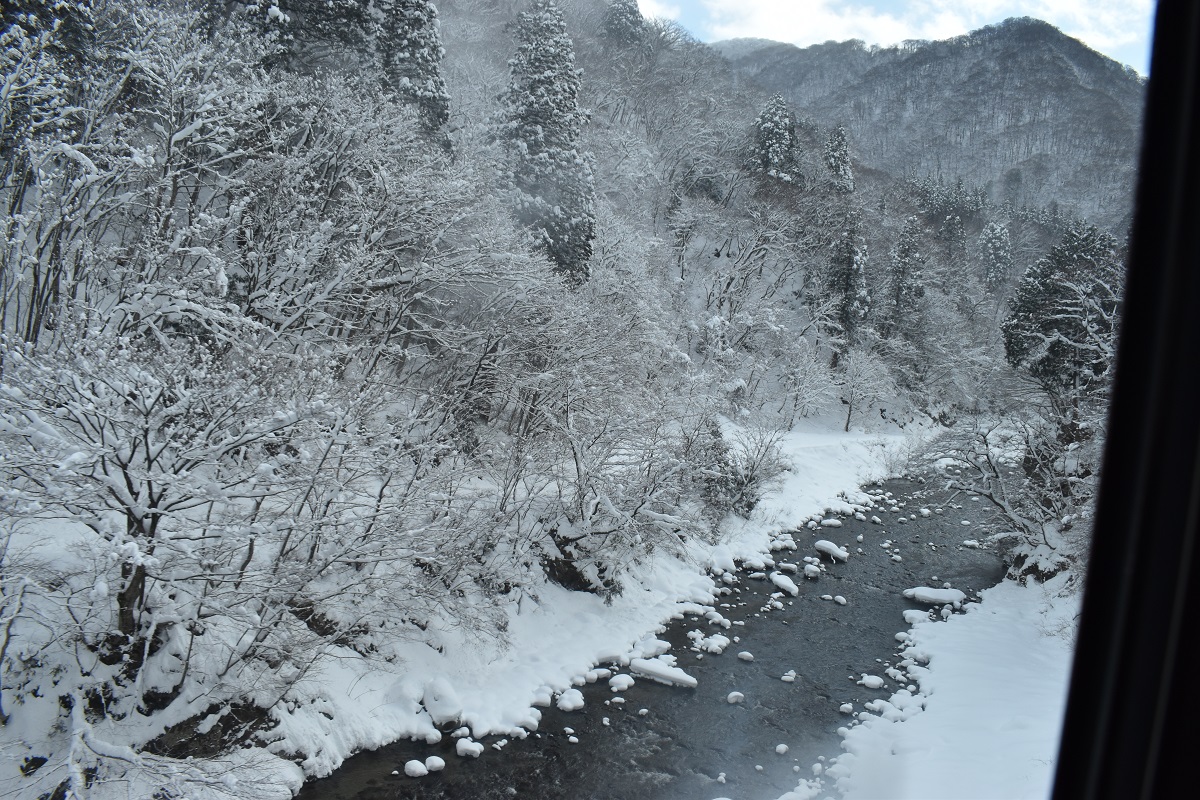
If there hadn’t been a heavy snow warning, I would have enjoyed the scenery of Jigokudani (Hell Valley) in Unzen Onsen and the frost (a phenomenon in which ice freezes over the trees all over the mountain), which can only be seen at this time of year, but the roads were closed due to the snow, so I just left my car in Obama Onsen and took the shuttle bus to and from Unzen Onsen.    It seems that this kind of experience is rare, but the heavy snow and low temperatures this year are abnormal.

However, the Shimabara Peninsula is rich in history and is full of things to see.    When Toyotomi Hideyoshi unified the country, he changed the territory of this region and established an exclave (Kojiro-Kuji) of the Nabeshima Domain (present-day Saga Prefecture) on the Shimabara Peninsula as a check against the Shimabara Domain and Satsuma Domain.   Although the kanji characters do not suggest such a reading, the area still retains the atmosphere of the Edo period district, and the streets lined with samurai residences remain as they were then.    Kojiro-Kuji is perfect for a short stroll.   The early-blooming cherry trees planted in front of the Nabeshima residence, whose original building has been preserved, were just about to bloom.

Kojiro-Kuji nabeshima house (2)
kobe station next to sea (1)

kobe station next to sea (3)

The Shimabara Railway, which runs leisurely along the coastline of the Shimabara Peninsula, and the Ariake Sea that spreads out behind it create a feeling of openness.   It seems that the station buildings closest to the sea are advertised as a selling point in themselves, with the opportunity to take photogenic photos, and in the case of the Shimabara Railway, the most popular is Ohmisaki Station, but Kobe Station also has a nice, old-fashioned feel to it.   The scenery is often used in commercials for soft drinks.    If you check the timetable in advance to see if there is an up or down train coming, you won’t miss the chance to take a photo.    Trains come about once an hour.    However, all the local train lines are struggling financially, and there is talk of closing the Shimabara Railway and replacing it with buses.    I hope the trains will continue.

kobe station next to sea (4)

Saying goodbye to the Shimabara Peninsula and heading to Nagasaki Airport, one must pass through Isahaya.    Speaking of Isahaya, a major political issue in the past was whether to open or close the floodgates of the Isahaya Bay reclamation project.   The river flowing into Isahaya was originally short, so heavy rains in the mountains directly led to flooding, and so reclamation work was carried out with the aim of improving drainage.    However, after the reclamation work, which involved destroying the tidal flats and building long dike with closed floodgates, seaweed cultivation in the Ariake Sea suffered devastating damage.   Fishermen filed an administrative lawsuit against the government, claiming that the floodgates had prevented the flow of abundant nutrients from the mountains into the Ariake Sea.    The government’s response changed several times with the change of administration, and judicial decisions were also in disarray.    In the end, the gates were not opened, and the matter was recently settled, but interest in the floodgates had already been lost among the public nationwide.   I have heard that the color of the seaweed in the Ariake Sea is getting worse, but this is a nationwide story.    A highway was built on top of the dike, but driving on it gives me mixed feelings, despite the beautiful scenery.

Once I cross the dike I enter Isahaya city.    If I had the time, I would pay a lot of money to eat the famous steamed eel, but here I head to Isahaya Shrine to receive some of the good fortune that comes with this season.   The torii gate is covered with a giant Otafuku face, and it is said that by passing through the mouth of this lucky charm, one will jump in and be granted good fortune.   It is easy to hit your head when passing through, and if you do, you will be given a bump on the head instead of good fortune.

isahaya shrine (1) Otafuku

Isahaya Shrine was built by imperial command of the emperor during the Nara period and served as the general guardian of Kyushu.    It was called Shimen-Gu, a name that comes from the Kojiki, an ancient Japanese historical book.   In the past, people believed that misfortunes came from some directions, so this shrine is said to ward off misfortunes from all directions and bring good fortune.    It is the same benefit as Jonangu Shrine in Kyoto, which is famous for its plum garden.

Detour (Potatoes from Nagasaki?)

Besides Isahaya, there is also another entrance to the Shimabara Peninsula, Tachibana Bay in the south.    As the Geopark says, the Chijiwa Fault, which was formed when the Shimabara Peninsula was pulled north and south, can be clearly seen from the Chijiwa Observatory facing Tachibana Bay.   However, what is important to note here is that potato cultivation in Japan began in Nagasaki, and even today Nagasaki potatoes are famous for their delicious taste.   Most Japanese people associate potatoes with Hokkaido as their place of origin, but the Japanese name for potatoes, “jaga,” was named after Jakarta, where they were imported, and was improved in Nagasaki.    However, the real place of origin of potatoes is the Andes.   At Chijiwa Observatory, you can buy “Jagachin,” which are whole potatoes marinated in seven different seasonings and then deep-fried.    Be sure to buy some and take a commemorative photo of yourself biting into it.


hill tour3 Prayer Slope (1)
Go back to itinerary