Nagasaki, a city of slopes
The history of Nagasaki began during the Sengoku period, when the first Christian warlord opened a trading port and, in exchange, guaranteed land and granted freedom for missionary work. Since then, Nagasaki has been developed into residential areas that climb up the mountains around the long, narrow inlet.

Naturally, the area is full of slopes, and many people have posted their impressions of these slopes on social media in an attempt to enjoy the scenery. The most popular place that everyone goes to is Dutch Slope, but if you are coming from Shinchi Chinatown, I recommend crossing the edge of the Chinese residence (“Tojin Yashiki”) and entering Dutch Slope from the middle, as it will make you feel like a resident.
Even more recommended is Aioi Jigoku-Zaka (Hell Slope) near Ishibashi Station on the tram line, which leads to the back entrance on the hill of Glover Garden, and in the entrance there is a sign board that says it is a test of physical endurance. Not confident in my physical strength, I took the inclined elevator (Glover Sky Road, for residents but free for tourists) to the top of the hill.
The view of Nagasaki’s residential areas clinging to the slope from here is breathtaking.

I’ve never been there, but it feels like La Paz, the capital of Bolivia. Apparently, housing at higher altitudes in La Paz is cheaper because the oxygen is thinner there, and the high-end residential areas are at lower altitudes. It’s the complete opposite of the upscale residential areas on the hills of Tokyo, but what about Nagasaki? Young people live at the bottom of the slope or suburbs to avoid the inconvenience, and only the elderly are left at the top of the slope. It’s hard work, but it’s good for their health.

On the other hand, the town has many slopes and is bowl-shaped, making for a beautiful night view. However, it is inconvenient to live there, so the number of vacant houses is increasing, and there are concerns that the night view will become hollow in the future.
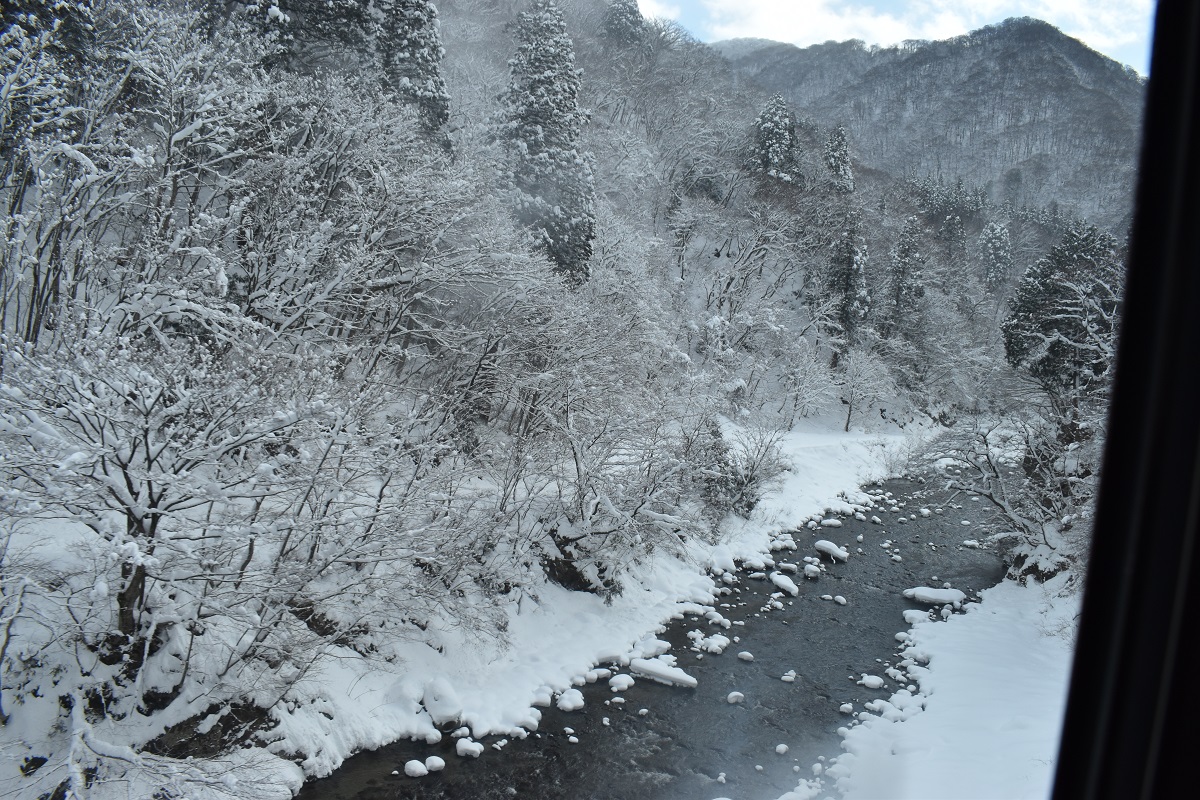
Anyway, this time the residential area with the entire slope covered in snow was beautiful, and from here you can also visit the Prayer Slope next to Oura Cathedral, famous for “Hidden Christians” discovered there for the first time in about 250 years, and Don-Don Slope, from which you can see the shipyards of Nagasaki Port, so I recommend you visit both.
Glover Garden is home to many buildings from the foreign settlement at the time, and also has boats used in the Nagasaki Kunchi Festival and dragons from the dragon dance on display, so there is a lot to see. We arrived at a time when it was snowing heavily, so we were able to take our time to look around the inside.
Detour
Nagasaki is famous for sweets that use a lot of sugar, as sugar was brought to the city from Portugal. Castella cake is a prime example of this, and it uses a surprising amount of sugar, so did you know that it’s completely unsuitable for dieting? There are also mysterious sweets that are very hard unless you heat them in the microwave, and are hollow inside. They are really dangerous for people with bad teeth.
However, for drinkers, there is a wide variety of fresh sashimi (raw fish). Even in the station building, they have the most delicious tuna bowls I’ve ever eaten. It’s great to leave a little rice and pour the dashi broth over it at the end to eat it as ochazuke. There are also tuna bowls sold by fishmongers around town, which I’m looking forward to next time.

Patience until darkness for cool lantern photos
Nagasaki Lantern Festival is just like the setting of “Spirited Away” produced by Studio Ghibli. The place where the main character, Chihiro, gets lost is a town decorated with lanterns. The pigs that appear in the story also appear as offerings, and the dragon that appears in the dragon dance is a deity that saves the main character. The rambunctious giant baby is part of the lantern decoration. You’ll have to find the witch lady and No-Face yourself.
The Nagasaki Lantern Festival venues are spread across the city, so it is difficult to see everything in one night. Depending on the venue, the lanterns are lit from 12:00 or 15:00, so I planned a route based on that, visiting the venues that were lit up earlier first and the venues where events were held later.
But even though it was winter at 15:00, Nagasaki is the westernmost part of Japan, so it was still light all around. When the lanterns are lit at 15:00, you won’t even notice them unless you get close to the statue.
In the end, I only managed to see the heart stone at 15:00 on Meganebashi(Spectacles) Bridge, and had to wait until it was completely dark before going back to see the yellow-toned lanterns.

Before lighting the lanterns, we recommend taking a leisurely stroll around Tojin-yashiki(Chinese houses district), Sofuku-ji Temple, and Kofuku-ji Temple, to think back to Nagasaki’s role as a gateway for trade with China. While the Dutch were confined to Dejima artificial island, the Chinese were restricted to living in a cone-shaped area. This is called Tojin-yashiki(Chinese Houses district), and an event is held in which people light candles and pray in four halls that were built for each of the Chinese people’s hometowns. Each hall enshrines the same god, but each one has a slightly different look. It consists of Kannon Bodhisattva, who is said to grant various blessings, Guan Yu, the god of business, Mazu (Empress of the Sea), who is prayed for safe voyages, and her companions, Clairvoyance, who can see things far away, and Wind-earing, who can hear sounds from afar. When the Chinese arrived in Nagasaki, they carried the statue of Maso enshrined on their ship to the Mazu Temple on the ground to give thanks for safety on the sea.
From here, you can cross a hill, view the 800-year-old camphor tree in Daitokuji Park (try the ume-gae mochi, closed on Wednesdays), and go through a seedy, narrow alleyway to reach the red-light district of that time.
From here, you can walk along the foot of the mountain to Sofuku-ji Temple with two gates as National Treasure, then the “Hamanmachi” venue, which has an arcade and where lanterns are lit from noon, and Kofuku-ji Temple, which is home to Manpuku-ji Temple, the head temple of the Zen(Obaku) sect in Kyoto (Hotei is the principal deity).
At Kofukuji Temple, the gate of the former Chinese residence has been relocated, and there is the remains of the building where Ryoma Sakamoto used to chat with Chinese people (destroyed by the atomic bomb). On the way, you will pass through a long, snobbish shopping street, and you will notice that there are so many closed shutters (FOR SALE signs).
After this, I passed by the Meganebashi(spectacles) Bridge, where the lights were turned on at 15:00, but it was too bright around me to see the lights. It was so cold with the snow and wind that I waited out the darkness at a nearby tea shop.
There are flashy lantern decorations and a stage for performances in Shinchi Chinatown venue. There were also 10 pig’s heads offered as offerings in the venue, but there was a sign posted saying that they were real.


For some reason, Okinawan Acer dance was also being performed at the main venue, Shinchi Chinatown, but Nagasaki is most famous for its dragon dance. Having seen the simple dances in Yokohama Chinatown, I didn’t have high expectations, but I was moved by the soulful dancing and the loud sound of the longest trumpets I had ever seen (longer (2m) and thinner than the vuvuzelas I saw at the FIFA World Cup in South Africa). The dragon dance is said to have developed from a rain-making ritual, and depicts a dragon swallowing a sphere representing the sun and moon, summoning rain clouds. On the other hand, the ceiling of the Buddha hall of the Zen temple also has a dragon painted on it, which is said to protect the Buddhist teachings and bring rain of teachings.
It was already dark, so I rushed to the bus stop near the main venue to take the free shuttle bus that I had booked online from 12:00 on the day to the ropeway station, but the bus never came. When I checked online, I found out that the ropeway was not operating today due to strong winds and snow. There was nothing else to be done, so I decided to take the tram back to see the lanterns at Meganebashi Bridge.


In addition, the free shuttle bus that goes to the ropeway station can only be booked online if your boarding and disembarking locations are the same, but there are only four buses per day and evening, so you should make your reservation online just noon.
By the way, the remaining two of Japan’s three greatest night views are Mt. Hakodate, which was cloudy and we couldn’t see anything when we got up there by ropeway, and Mt. Maya in Kobe, which we didn’t have time to see during 15-hour survival traverse race of the entire Rokko mountain range.

No one knows that Hachinohe alone has three national treasures

The Jomon cultural area can be found in unexpected places. The Suwa region has long been famous for the area because we know that the Jomon people came from all over Japan to search the place of production of obsidian, the raw material for arrowheads. But the Hokkaido/Northern Tohoku Jomon Archaeological Sites, which are registered as a UNESCO World Heritage Site, had gone completely unnoticed (no attention was paid to them). They lived in Hokkaido and northern Tohoku, separated by the strait, for over 10,000 years, forming the same cultural sphere. We know that they were part of the same cultural sphere because the clay figurines and pottery normaly made by women are almost the same and especially the patterns on them are the same, which means that women of the same blood traveled between these cultural spheres.

There is the Korekawa Jomon Museum in the outskirts of Hachinohe, where there is a clay figurine with palms together in a sitting position as the National Treasure. I have never seen a sitting position before. This clay figurine has female genitalia, so she may be praying for childbirth or a child. We know that people have been praying with their hands together since the Jomon period. The Venus of the Suwa region as the National Treasure also looks like a pregnant woman.

Also close to Hachinohe Station is Kushibiki Hachiman Shrine, the guardian deity of the Nanbu clan that has been in operation since the Kamakura period. Hachiman Shrine is a shrine that offers eternal good fortune in war, and as such, armor and helmets from the Kamakura and Nanboku-cho periods are enshrined there. However, these national treasure armor and helmets are more magnificent works of art than armor suitable for fighting.
This shrine also has something unique: at the entrance to the shrine, there are a pair of guardian lion statues, but here they are horses statues. On the side of the main shrine there is a wooden carving of a kappa being trampled by a hawk because of its mischievous behaviour. Later, when the Nanbu clan was transferred to Tono in Iwate Prefecture, this kappa legend was transferred with it and forms part of the Tono Stories.
Detour
The Sannai-Maruyama ruins, part of the Hokkaido/Northern Tohoku Jomon Archaeological Sites as a UNESCO-registered cultural heritage site, is located near Shin-Aomori Station on the Shinkansen line. Traces of a village that existed for nearly 2,000 years during the Jomon period remain vividly. Large-scale raised-floor buildings and pit dwellings have been restored.

“Enburi” is HIPHOP, a festival that has been going on for over 800 years to awaken spring
The dance, representing cultivating the fields in the face of the harsh natural environment and praying for a good harvest, has been designated an Important Intangible Folk Cultural Property of Japan. The name Enburi comes from the name of a farm tool used to plow fields. The event is scheduled to be held every year from February 17th to 20th, in the middle of the coldest weather, making it an incredibly spirited time to awaken spring. The dancer wears a eboshi hat shaped like a horse’s head, and dances magnificently, swinging his head from side to side. This can also be seen in hip-hop dance, which includes snake choreography.
Teams are formed in each region and the tunes and movements are passed down. There are two types of Enburi: the slow and graceful “Naga-enburi” and the fast and heroic “Dosai-enburi.” In the former, one dancer wears an eboshi hat with a peony flower and other dancers surround him performing different dances, while in the latter, all dancers wear eboshi hats with five-colored tassels and perform the same dance. The dance movements represent the entire process of rice farming, from sowing seeds in the seedbed, to plowing the field with a horse, planting the rice, and finally harvesting. Furthermore, children (and occasionally the elderly) perform blessing performance, which is positioned as something to enjoy during breaks from farm work. The performance includes dancing with hoops that have coins attached to them, dancing with pine branches, and sea bream fishing. It seems that spectators sometimes attach gift money to the end of fishing hooks.
<Dosai-Enburi by Nukatsuka team>
<Naga-Enburi by Nakaibayashi team>
The teams are invited to perform Enburi at various stores and can be seen all over town during the festival. The Tourist Association has also created a separate event program and arranged a public stage. The highlight of this program is the “Garden Enburi” which takes place in the courtyard of Kōjōkaku, a mansion of a former financial clique family in Hachinohe that is now registered as tangible cultural property, located in the center of Hachinohe. You can watch the evening Enburi while sipping on sweet half sake and rice cracker soup in a tatami room. Reserved seats are sold at the convenience store Lawson from one month in advance, so if you want to watch the show, you should definitely reserve a seat in the first row. The competition for the first row seats is fierce. If you’re in the first row luckily, you can set up a video tripod. Heat packs are distributed to all audience and there is a bonfire, but in any case, you’ll be watching outside in the cold, so you’ll need to wear clothes to protect yourself from the extreme cold.
The second recommendation is the “Brewery Storehouse Enburi” that Hachinohe Shuzo(Brewery) accepts only during this season as a set with a tour of the brewery. Online reservations are required, but there is less competition than for the Garden Enburi. Here, in a warm room, you can enjoy some excellent sake while watching the dancers perform right in front of you, almost touching them, making it the perfect opportunity to see their intricate movements. During this period, several tours are scheduled, so you can check out both Naka-enburi and Dosai-enburi. It seems that the brewers at this brewery are also participating in one of the groups. To get to Hachinohe Shuzo( Brewery), you’ll need to take the JR Hachinohe Line from Hachinohe Station to Mutsuminato Station, or take a bus from downtown Hachinohe, but it’s quite close.
<Brewery storehouse Enburi(Dosai) by Hashikami-Toriyabe team>
Sake brewing is also at its peak at this time of year, so we recommend visiting the two major sake breweries: Hachinohe Shuzo, where you can enjoy the Brewery storehouse Enburi performance, and Hachinohe Shurui, located in the city center and with a modern shop building. Buying sake is a bulky process, but Hachinohe Shurui is surprisingly good at shipping sake with other manufacturers at a low price. I bought two 1.8L bottles at Hachinohe Shurui and had them delivered.
<Hachinohe Shuzo>
<Hachinohe Shurui>
Detour
Hachinohe Shuzo is located near JR Mutsuminato Station. It is close to the Tatehana Wharf where the huge and chaotic morning market is held, but of course the market is not open in the middle of winter (though it does have a special market during the New Year). However, in front of the station, there is a fish and vegetable market in a building that is open from morning until noon, and everything is very cheap. Sashimi(sliced raw fish) is also packaged in individual portions, so you can choose what you like, and if you order additional rice and miso soup at a table in the back, you can have a decent meal.
Also nearby is Minato Shokudo(dining room), a popular restaurant on social media, where you can try their seasoned flounder rice bowl, although you may have to wait in line (in fact, if you write your name in a notebook at the reception desk, they will call you on your mobile phone when it is your turn). Apparently, in good seasons, you may have to wait 2-3 hours, but this was my fourth visit to Hachinohe and the first time I tried it, it was mid-winter, so I only had to wait an hour. Most people arrive on the JR Hachinohe Line and wait in line, and when you board the two-car train at Hachinohe Station, you have to get in directly behind the driver’s seat in the front car because Mutsuminato Station is an unmanned station and the driver of the one-man train also checks the tickets of passengers getting off from inside the train. I didn’t notice it at first, and assumed that all the doors would open if I pressed the button beside doors when I got to the station, but I was surprised when everyone moved to the front. Only one door in the front car opened because of the ticket gate. I later found out that all of these people were heading to Minato Shokudo! After getting off at the unmanned station, I made a furious dash and overtook about 10 people, but the enemy came in a group of several people, and one of the faster runners got in line first, and the person I had overtaken got in front of the line.
There was nothing to do during the hour-long wait, so I decided to take a walk to the free observation tower (Grette Tower Minato) on the cape beyond Tatehana Wharf and stared blankly at Hachinohe Port, which turned out to be quite enjoyable. To the east we could see Kabushima island, where black-tailed gulls had not yet arrived because it was not yet spring, and to the west we could see the majestic snow-capped Mount Hakkoda, and to the south we could see downtown Hachinohe and the forest of Chojayama Sinra Shrine, which is the venue for the polo matches at the summer Sansha Festival, as if they were right in front of us, and the hour passed by in the blink of an eye. Needless to say, the long-awaited seasoned flounder rice bowl was as delicious as SNS had said. For an additional 200 yen, you can have the miso soup turned into Hachinohe’s specialty rice cracker soup, but there’s no rice cracker soup with a more delicious broth than this one, so be sure to order it. After that, we once again made a mad dash to Brewery storehouse Enburi, for which we had a reservation starting at 2 p.m.


One of the three sacred places for railway fans
The view of the railway that goes around the mountains is itself a tourist destination. Jungfrau Railway on the European Alps is a typical example, but due to Hakone’s proximity to Tokyo, Hakone Tozan Railway is now overflowing with foreign tourists. In order to transfer at Hakone-Yumoto Station and secure a good seat on the Hakone Tozan Railway, the front car of the train from Odawara Station is as full as a commuter train. I had mixed feelings when I saw foreign tourists dashing onto the Hakone-Yumoto Station platform and being the first to secure seats on the left side for a better view.

Now, on the Hakone Tozan Railway, you can experience three switchbacks, but here on the Hisatsu Line heading towards Hitoyoshi in Kumamoto Prefecture from Hayato in Kagoshima Prefecture, you can see two switchbacks and a loop at the same time around Okoba Station. It’s sad that railway transportation has not resumed as Hitoyoshi is currently recovering from the flood damage, but instead you can walk along the tracks at the site and get a feel for it. Furthermore, in February, white flowers of the nearby Hitoyoshi plum grove are beautiful, and in March, the cherry blossoms along the railroad tracks inside Okoba Station are also beautiful.
In fact, the sacred place for railway fans is not here, but the landscape from the train window at “Yatake Goe”, which steeply climbs the inner wall of the Kakuto Caldera Somma, reaching the highest point on the line. However, railway fans naturally enjoy the switchbacks and a loop around Okoba Station as well. To get there by car, you need to go from the bottom of the caldera through the outer rim of the mountain, so the road is connected twice by loop bridges at the front and back.

Now, regarding the station building of Okoba, there is an urban legend that if you put a business card on the wall, you will get promoted, and when I went there, I found business cards stuck all over the walls of the station building. Maybe you’ll find a business card of someone you know. Now, in preparation for the reopening of the railway, they have been completely removed, and I wonder where the removed business cards are. It is of great interest to know what happened to the career afterward of the person who inserted the business card.


Is the priest of Daizenji Temple (National Treasure) a winemaker?
Daizenji Temple is also called Grapes Temple. This is not because the priest is passionate about grape cultivation and wine making. It is said that during the Nara period, the monk Gyoki enshrined the Yakushi Sanzon holding a bunch of grapes that appeared in his dreams. In fact, the priest and temple officials grow grapes on the premises and set up tanks to make wine.


At the rest area with garden view, a glass of homemade (or sould I say “templemade”) wine is sold for 300 yen, and it comes with four delicious Koshu grapes as a snack, so it’s a good deal. I ended up buying a bottle(1800ml) of wine(Muscat Bailey A) as a souvenir.
Well, there are three elements that make this temple famous.
First, the Yakushi-do Hall and the Zushi that houses the Buddha statues are national treasures. The roof of Yakushido is made of cypress bark, and its curved shape is harmonious and beautiful. It was built during the Mongol invasion period of the Kamakura period, making it the oldest wooden structure in the Kanto region. In Kyoto, Senbon Shakado was built around the same time. The Nikko(sun) and Gakko(moon) Bodhisattvas and the 12 divine generals enshrined inside are very well-designed and give a sense of newness despite being old, but the story of the woman who explains them is too comical. I feel like it’s a bit of a mismatch.

Next, it is said that this was the temple where Katsuyori Takeda, who was defeated by the Oda army and headed for Mt. Tenmoku, stayed overnight praying for a counterattack. These records of Takeda’s demise remain in this temple.
Finally, at the end of the Edo period, the shogunate army and the Shinsengumi, who had a final battle with the new government army, established their tentative headquarter on the west side of Daizenji Temple to prevent the temple from being damaged by war.
The captain was Isamu Kondo, and the main gate of Daizenji Temple is depicted on the background of the nishiki-e(color print). The purpose of this battle was to seize Kofu Castle first and prevent the new government forces from invading Edo, but they were defeated by the new government forces led by Taisuke Itagaki. This was exactly the same history as when Katsuyori Takeda tried to reach Seiunji Temple for Reborn, but was preempted by the Oda army.

Detour
Speaking of food in Yamanashi, it’s “Houtou.”

It’s hard to tell how it’s different from udon, but the flour is kneaded without adding salt to keep it from becoming chewy, and then it’s cut up and simmered with vegetables without waiting too long. Therefore, some of the noodles will dissolve into the soup, creating a soup unique to “Houtou.”

Enjoy houtou at a house designated as a registered tangible cultural property. The house “Minaki” is an old Japanese zelkova house built in 1896.


