Hitoyoshi is my top 3 hardest places to get to. It’s located deep in Kumamoto Prefecture, but I noticed on the map that it’s surprisingly close to Kagoshima Airport.
hitoyoshi station garage
hitoyoshi station closed due to disaster
hitoyosshi kaname fall4 chestnut bento in front of fall
First, I went to Hitoyoshi Station from the airport and bought the famous chestnut bento (lunch box). Even the shape of the bento is chestnut. Before the flood, the old-fashioned ekiben vendors on the platform used to shout out their good-old cries. Now, I pass by the deserted station building and buy a bento at the bento shop next to the station building. With a bento in hand, I head to Kaname Falls (Ohdaki), a waterfall that tumbles vertically down a columnar jointed wall, and eat my lunch while being showered with the spray from the falls. Although the Medaki waterfall is nearby, it is impossible to get any closer due to the large stones and timber that were washed away by the flood. This shows the extent of the damage caused by the flood.
hitoyoshi kaname fall2suiranro1 flood water level
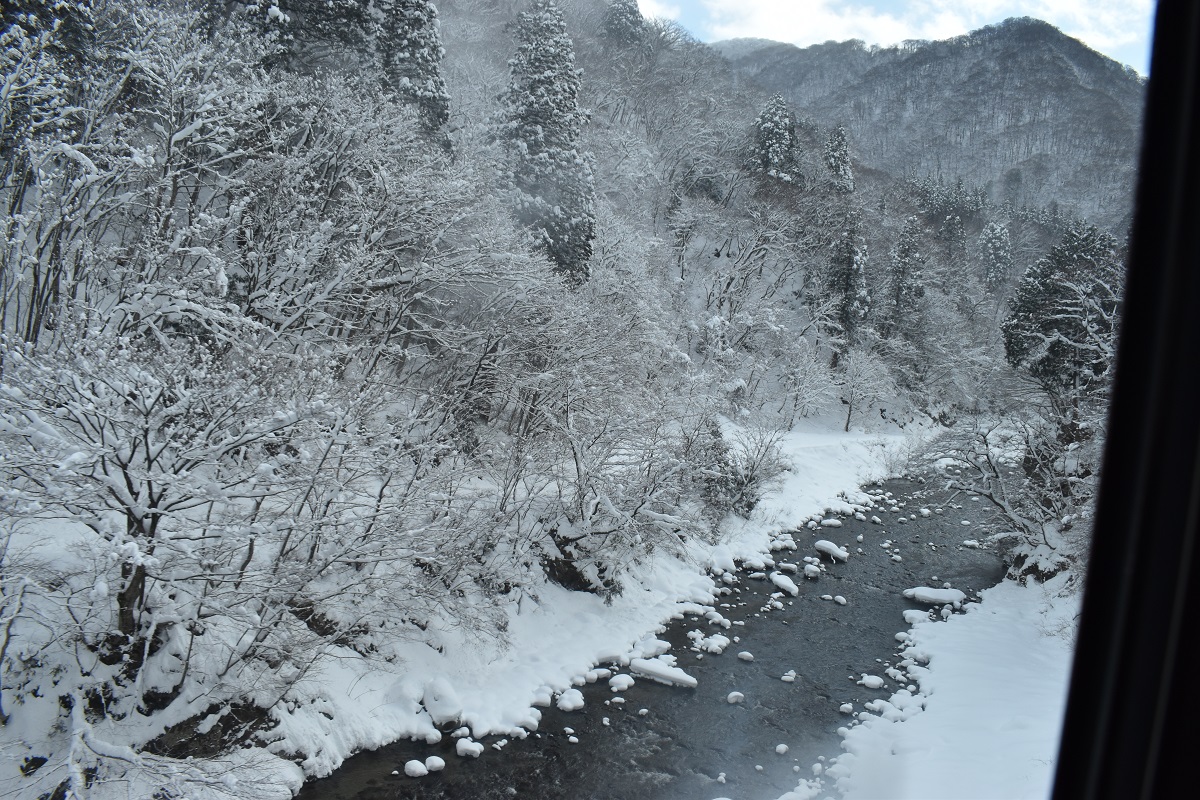
At the hotelwhere I’m staying tonight, there is a marking near the ceiling of the front desk showing the water level of the Kuma River when it overflowed. Apparently, the flood caused driftwood from nearby areas to flow into the Kuma River, where it became caught on railway bridges and other bridges, causing the muddy waters to overflow and wash away the entire town. Now, the Kuma River flows calmly and steadily in front of the hotel.
suiranro2
kuma river3
suiranro3 dinner
suiranro4
suiranro5
suiranro6
suiranro7 in memory of steam locomotive
suiranro8
suiranro9
suiranro11 sweetfishes
suiranro12 tempura
suiranro13
suiranro14
suiranro15
suiranro16
suiranro18
suiranro17
suiranro19
suiranro20 bonito flakes
suiranro21
Aoi Aso Shrine is a national treasure that has managed to survive under such circumstances, and it is definitely worth visiting. The shrine’s sanctuary is generally not open to the public, but an elderly man who seemed to be the chairman of the preservation society, who was watching over the restoration work around the shrine, invited me to see the sanctuary. There is a pamphlet with beautiful color prints, which is free of charge. What is amazing is the 400-year-old building, the thatched roofs of the tower gate and worship hall, the colorful decorations and colors of the Momoyama style, and the intricate plaster decorations of the inner sanctuary. It has an overwhelming presence.
aoiaso shrine15
aoiaso shrine1
aoiaso shrine2
aoiaso shrine4 hengaku
aoiaso shrine5 demon
aoiaso shrine11
aoiaso shrine12
aoiaso shrine6 inside
aoiaso shrine7 inside
aoiaso shrine8 inside
aoiaso shrine9 up and down dragons
aoiaso shrine10 protected by lions
Detour
eikoku temple5 ghost legend
During the Satsuma Rebellion, Takamori Saigo’s troops traveled around the country fighting the Meiji government forces, and here in Hitoyoshi, they had their headquarters at Eikokuji Temple. This place is also known as the Ghost Temple, and a hanging scroll of a ghost has survived the ravages of war without being burned. I found it interesting to read a piece about what one would say if someone came to take them from the afterlife. There are many other attractive temples and shrines remaining in the Hitoyoshi Basin. As the area has been ruled by the Sagara clan since the Kamakura period, it seems that many things of great historical value remain.
eikoku temple7 if someone comes to pick you up from the other world
eikoku temple1 saigo army headquqrter
eikoku temple2
eikoku temple3
eikoku temple4 ghost in the pond
eikoku temple6 cannonball
brewery3
Near Eikokuji Temple is Hitoyoshi Castle, famous for its cherry blossoms, and the famous rice shochu brewery Sengetsu, which you are welcome to come and sample the drinks. The shochu “Kawabe,” which can only be purchased locally, uses water from the clear Kawabe River, which flows into the Kuma River, but recently there has been talk of building a dam to prevent flooding, which worries me.
Shimabara Peninsula was the first place in Japan to be certified as a UNESCO Global Geopark. The peninsula is still pulled north and south, causing the earth in the middle to split apart and become a fault, making it easier for heat sources to rise up. This is the Unzen volcano. In 1991, Mount Unzen erupted, causing a large pyroclastic flow to flow from the mountain into the sea. This was the first time that the term “pyroclastic flow” was recognized in Japan, bringing with it terrifying memories.
chijiiwa fault (1)
The faults allow three different hot springs (Obama Onsen, Unzen Onsen, Shimabara Onsen) to bubble up, and spring water also bubbles up. In Obama Onsen, steam erupting from the earth can be used to make steamed dishes, just like in Beppu Onsen. Unzen Onsen was a summer resort where Westerners came to enjoy vacations to escape the summer heat of Shanghai and Nanjing during the time China was under colonial rule. Shimabara is famous as the place where the people suffering under oppression fought against the Tokugawa shogunate by not hidding Christian faith; after this, their descendants hid their faith throughout the long Edo period (as hidden Christians) until the Meiji.
unzen hotspring in snow (1) snowing
unzen hotspring in snow (2)
unzen hotspring in snow (3)
unzen hotspring in snow (4) morning
unzen hotspring in snow (5) after snowing
unzen hotspring in snow (6)
unzen hotspring in snow (7) entrance of hotel
obama hotspring (1)
obama hotspring (2)
obama hotspring (3)
obama hotspring (4) Geothermal cooking
If there hadn’t been a heavy snow warning, I would have enjoyed the scenery of Jigokudani (Hell Valley) in Unzen Onsen and the frost (a phenomenon in which ice freezes over the trees all over the mountain), which can only be seen at this time of year, but the roads were closed due to the snow, so I just left my car in Obama Onsen and took the shuttle bus to and from Unzen Onsen. It seems that this kind of experience is rare, but the heavy snow and low temperatures this year are abnormal.
Kojiro-Kuji street (3)
Kojiro-Kuji street (2)
Kojiro-Kuji street (1)
Kojiro-Kuji nabeshima house (1)
Kojiro-Kuji street (4) Mt.Unzen
However, the Shimabara Peninsula is rich in history and is full of things to see. When Toyotomi Hideyoshi unified the country, he changed the territory of this region and established an exclave (Kojiro-Kuji) of the Nabeshima Domain (present-day Saga Prefecture) on the Shimabara Peninsula as a check against the Shimabara Domain and Satsuma Domain. Although the kanji characters do not suggest such a reading, the area still retains the atmosphere of the Edo period district, and the streets lined with samurai residences remain as they were then. Kojiro-Kuji is perfect for a short stroll. The early-blooming cherry trees planted in front of the Nabeshima residence, whose original building has been preserved, were just about to bloom.
Kojiro-Kuji nabeshima house (2)
Kojiro-Kuji nabeshima house (3)
Kojiro-Kuji nabeshima house (4)
Kojiro-Kuji nabeshima house (5)
Kojiro-Kuji nabeshima house (6)
Kojiro-Kuji nabeshima house (7)
Kojiro-Kuji nabeshima house (8)
kobe station next to sea (1)kobe station next to sea (3)
The Shimabara Railway, which runs leisurely along the coastline of the Shimabara Peninsula, and the Ariake Sea that spreads out behind it create a feeling of openness. It seems that the station buildings closest to the sea are advertised as a selling point in themselves, with the opportunity to take photogenic photos, and in the case of the Shimabara Railway, the most popular is Ohmisaki Station, but Kobe Station also has a nice, old-fashioned feel to it. The scenery is often used in commercials for soft drinks. If you check the timetable in advance to see if there is an up or down train coming, you won’t miss the chance to take a photo. Trains come about once an hour. However, all the local train lines are struggling financially, and there is talk of closing the Shimabara Railway and replacing it with buses. I hope the trains will continue.
kobe station next to sea (4)
Saying goodbye to the Shimabara Peninsula and heading to Nagasaki Airport, one must pass through Isahaya. Speaking of Isahaya, a major political issue in the past was whether to open or close the floodgates of the Isahaya Bay reclamation project. The river flowing into Isahaya was originally short, so heavy rains in the mountains directly led to flooding, and so reclamation work was carried out with the aim of improving drainage. However, after the reclamation work, which involved destroying the tidal flats and building long dike with closed floodgates, seaweed cultivation in the Ariake Sea suffered devastating damage. Fishermen filed an administrative lawsuit against the government, claiming that the floodgates had prevented the flow of abundant nutrients from the mountains into the Ariake Sea. The government’s response changed several times with the change of administration, and judicial decisions were also in disarray. In the end, the gates were not opened, and the matter was recently settled, but interest in the floodgates had already been lost among the public nationwide. I have heard that the color of the seaweed in the Ariake Sea is getting worse, but this is a nationwide story. A highway was built on top of the dike, but driving on it gives me mixed feelings, despite the beautiful scenery.
Once I cross the dike I enter Isahaya city. If I had the time, I would pay a lot of money to eat the famous steamed eel, but here I head to Isahaya Shrine to receive some of the good fortune that comes with this season. The torii gate is covered with a giant Otafuku face, and it is said that by passing through the mouth of this lucky charm, one will jump in and be granted good fortune. It is easy to hit your head when passing through, and if you do, you will be given a bump on the head instead of good fortune.
isahaya shrine (1) Otafuku
Isahaya Shrine was built by imperial command of the emperor during the Nara period and served as the general guardian of Kyushu. It was called Shimen-Gu, a name that comes from the Kojiki, an ancient Japanese historical book. In the past, people believed that misfortunes came from some directions, so this shrine is said to ward off misfortunes from all directions and bring good fortune. It is the same benefit as Jonangu Shrine in Kyoto, which is famous for its plum garden.
isahaya shrine (2) backside of torii gate
isahaya shrine (3)
isahaya shrine (5) large camphor tree
isahaya shrine (4) Amabie
Detour (Potatoes from Nagasaki?)
Besides Isahaya, there is also another entrance to the Shimabara Peninsula, Tachibana Bay in the south. As the Geopark says, the Chijiwa Fault, which was formed when the Shimabara Peninsula was pulled north and south, can be clearly seen from the Chijiwa Observatory facing Tachibana Bay. However, what is important to note here is that potato cultivation in Japan began in Nagasaki, and even today Nagasaki potatoes are famous for their delicious taste. Most Japanese people associate potatoes with Hokkaido as their place of origin, but the Japanese name for potatoes, “jaga,” was named after Jakarta, where they were imported, and was improved in Nagasaki. However, the real place of origin of potatoes is the Andes. At Chijiwa Observatory, you can buy “Jagachin,” which are whole potatoes marinated in seven different seasonings and then deep-fried. Be sure to buy some and take a commemorative photo of yourself biting into it.