
Many municipalities across Japan organize “Fox Wedding Processions” as tourist attractions—recruiting a bride and groom to reenact this traditional supernatural phenomenon—and claim to be the original home of the custom. Among them, the Fox Wedding in Tsugawa is the oldest, with roots dating back to classical literature.
These eerie phenomena fall broadly into two categories: “countless mysterious lights” that could easily be mistaken for a swarm of paper lanterns, and “sunshowers”—rain falling while the sun is shining. Both types are associated with foxes—creatures said to possess the power to bewitch humans—but the phenomenon in Tsugawa belongs to the former category; it is said that mysterious lights appear at night on Mt. Kirin, located on the opposite bank of the Agano River, which flows beside the town. The event, which draws large crowds, takes place over a weekend in June and continues into the night. During the weekend, a steam locomotive runs along the line connecting to Aizu, located in the upper reaches of the Agano River.


The reason there are so many shops in this town specializing in fermented foods lies in Tsugawa’s geographical location. During the Edo period, the primary mode of transport involved *Kitamae-bune* (merchant ships) that navigated the relatively calm Sea of Japan coast rather than the Pacific side.
The Agano River flows wide and calm as far as Tsugawa, making it navigable for transporting materials; at this point, goods were transferred to horses for delivery to or shipment out of Aizu. The combination of seafood and salt brought from Niigata and rice arriving from Aizu gave rise to the production of *koji*-based foods in Tsugawa. The miso purchased at Yamazaki Koji-ya lacks any harshness—offering instead a natural sweetness—and transcends the ordinary concept of miso.

This area is also said to be the birthplace of the *gangi*—wide, arcade-like eaves extending from shopfronts over the street—which were created in snow-prone Niigata to allow people to move about on snow-covered roads. Isabella Bird, who traveled through Japan’s remote interior during the early Meiji era, also noted their existence in her travelogue.
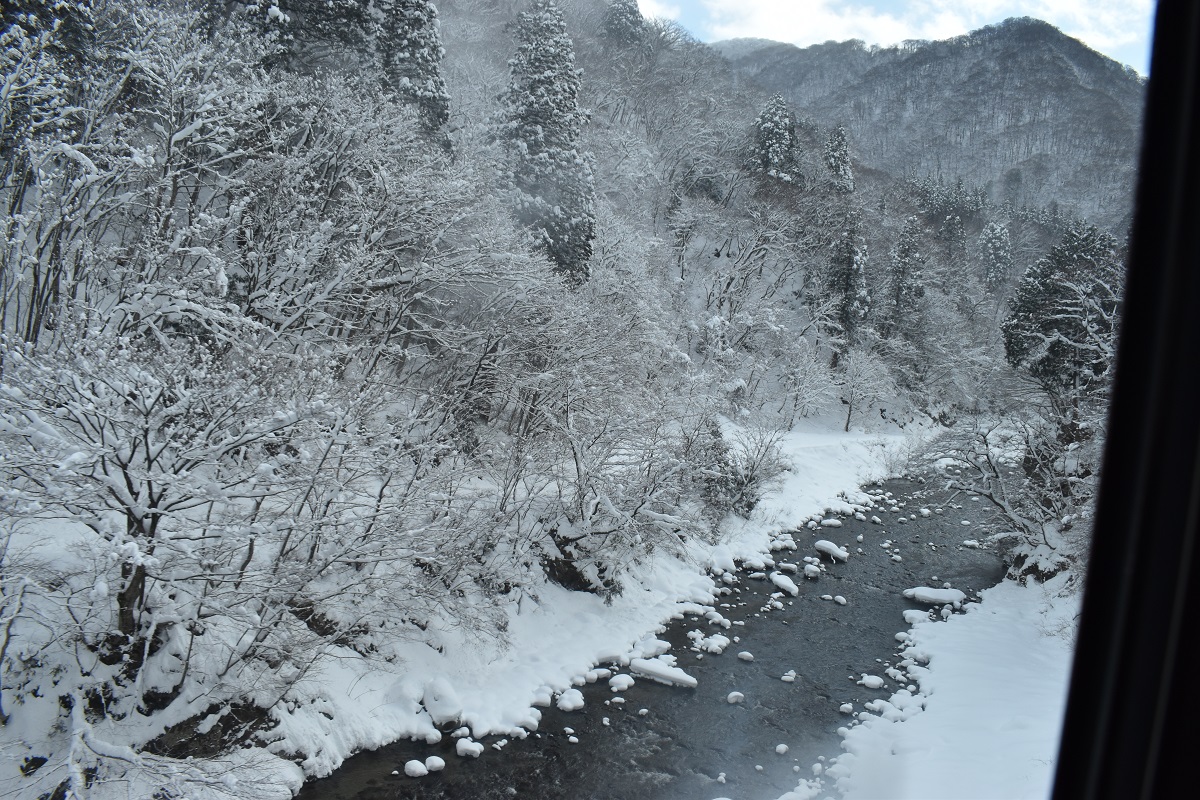
She reportedly described the Agano River—which widens significantly starting at Tsugawa—as resembling the Rhine. Perhaps she likened the sheer cliffs of Mount Kirin in Tsugawa to the Lorelei Rock; then again, one might easily sail right past the actual Lorelei Rock without even noticing it, were it not for the announcements made on board. Indeed, so many tourists look around restlessly when the announcement is made. The Lorelei Rock is counted among the world’s “three major disappointments“; the other two include the Little Mermaid statue in Copenhagen—where an industrial zone is visible on the opposite shore—and the Manneken Pis in Brussels, which, despite being right next to the central Grand Place, is so small that one might easily walk right past it without noticing. If the Manneken Pis were huge, it would just look like an adult urinating while standing, so perhaps it couldn’t be helped.
Detour 1 (Huge ceder)
Near the town of Tsugawa stands the Shogun Sugi, a cedar certified by the Ministry of the Environment as the largest in Japan—surpassing even the famous Jomon Sugi of Yakushima. Its trunk circumference is said to be approximately 20 meters, though it is unclear exactly where that measurement is taken. On the other hand, people cheat on where they measure to make their waists look slimmer. Although the main trunk has fallen, multiple branched trunks surrounding it rise up together, towering high toward the sky. With an estimated age of 1,400 years, it dates back to the time when Prince Shotoku was alive. Incidentally, the name “Shogun” (General) is derived from the military commander who subjugated the Tohoku region during the Heian period.


Detour 2 (Roof tiles)
While tourist destinations showcasing pottery-producing regions can be found all over Japan, it is rare to find a place like Aga City that promotes factories manufacturing roof tiles as a tourism asset. These factories are clustered where the Agano River emerges onto the plains, forming a walking path known as “Kawara Road” (Tile Road). While there are facilities like a bus stop house and restrooms made entirely of roof tiles, as well as a cafeteria featuring tile-based plates, the display that allows visitors to take photos of themselves appearing to sit atop a tiled roof is sure to be a hit on Instagram. However, since roof tiles aren’t exactly the sort of thing people buy as souvenirs, a bit of creative ingenuity is required.


Because the region experiences heavy snowfall, the roof tiles used there must offer excellent thermal insulation and cold resistance; made from iron-rich clay, they fire into a distinctive lead-gray color. In recent years, however, modern Japanese homes have shifted toward lighter structural materials to reduce construction costs, leading to a move away from traditional tiles in favor of slate roofing—making beautiful tiled roofs an increasingly rare sight in urban areas. A factory belonging to Yasuda Yogurt—famous for its dairy products—is located right next to the tile factory.
Today’s INN (Seiko-kan)

Despite being located in an area with such heavy snowfall, the building is a three-story wooden structure and itself Nationally Registered Tangible Cultural Property, so the masterful skills of the carpenters remain in many places. It is a long-established inn featuring a radon hot spring—a rarity even on a national scale. Breathe in the radon-rich air and revitalize yourself. The meals are delicious, too, featuring primarily local ingredients.


