Weeping cherry blossoms are more wabi-sabi than Kyoto

weeping cherry blossoms in Shofukuji temple (2)

Heading west from Kagemori Station on the Chichibu Railway, you’ll find a series of temples along the line, each boasting magnificent weeping cherry trees.     It’s a bit of a distance, but it’s a leisurely stroll along the country road, admiring the cherry blossoms planted here and there along the way.    Incidentally, the Arakawa River, which flows through downtown Tokyo, runs along the railway line.     Here, it carves a deep gorge.

Shofukuji Temple

First, I started walking from Bushu-Hino Station.     Although there were no signs, I climbed up beside a farmhouse and suddenly Shofuku-ji Temple appeared.     The sight of the cherry blossoms adorning the temple gate, which you can see when you look up the stairs, is truly breathtaking.    This spot is on a slight hill, so you can see the Chichibu Basin beyond the curtain of weeping cherry blossoms in front of you, with cherry blossoms visible everywhere.      You can also see the Chichibu Railway, and you’ll probably even see the steam locomotives moving along, spewing black smoke.

Seiunj Temple and Wakajishi Shrine

Next, we head towards the weeping cherry tree forest at Seiunji Temple, which is often seen on posters.     Along the way, we pass a shrine with a sumo wrestling ring.    The weeping cherry trees at Seiunji Temple are simply breathtaking.     If you climb the stairs of the adjacent Wakajishi Shrine and look down from above, you can enjoy an even more spectacular view of the weeping cherry forest.    Incidentally, the protective statue at the entrance of this shrine is a wolf, not a guardian lion.     Apparently, they light up the shrine at night during the cherry blossom festival, and the fact that there are stalls selling farming tools gives it a very rural festival feel.

        source: Chichibumovies

Chosenji Temple

Finally, we visit Chōsenji Temple, famous for the revival of a giant weeping cherry tree that had once declined in vitality.     Weeping cherry trees bloom earlier than Somei Yoshino cherry trees, so the giant white weeping cherry tree here has already shed its blossoms, but the temple grounds are beautifully maintained.    Furthermore, this temple is worth visiting this year because it is unveiling its hidden Buddha statue for the Year of the Horse.      However, since the unveiling is taking place in the back of the temple hall, which is quite dark, it is very difficult to see the face of the Kannon statue, making it almost as if it were not unveiled at all.

From here, I headed towards Urayamaguchi Station, surrounded by cherry blossoms, and returned to my accommodation.

weeping cherry blossoms in Seiunji temple (2)
Go back to itinerary

Securing a good location is crucial for collaborative photos

Bushu Hino Station (5)

Along the Chichibu Railway line, especially around the stations, weeping cherry trees are densely packed.     What’s more, they’re not lined up in an orderly fashion, but rather grow naturally, which is what makes them so appealing.    These photos, featuring cherry blossoms alongside a quaint old train station, are a classic example of cherry blossom photography.

Moreover, since the steam locomotive runs on weekends from spring to autumn, it would be a shame not to take photos of the steam locomotive and cherry blossoms together.     However, securing a good spot is crucial for taking these kinds of photos.    But, Chichibu isn’t overly touristy, so even photography enthusiasts are generally calm, and finding a good spot is still a peaceful affair.

Bushu Hino Station (4)SL fans

A train whistle echoes in the distance, letting us know it’s getting closer.      Soon, the hissing sound of steam can be heard traveling along the tracks.    If you choose a location with a slope, you can capture the sight of black smoke billowing around cherry blossoms.     The steam locomotive seems to approach slowly, but once it’s in front of you, it suddenly speeds past.

My usual favorite photo spot is around Bushu-Hino Station.     There’s a small level crossing without barriers, and an automated voice warns you “Dangerous!” if you try to cross it, but people who don’t know about the automated voice system are startled by the voice and almost trip, so it’s hard to tell which is more dangerous.

If you walk about 20 minutes uphill from this railroad crossing, you’ll find a popular soba restaurant that only serves 49 bowls a day.     The owner apparently checks the quality of the soba for one bowl each day, but you can’t help but think, why not just make 51 bowls?    A score of 80 points was posted inside the restaurant at that day.     It was indeed delicious. Soba noodles are a living thing, so eat them all first before starting on the side dishes.    Also, since it’s a mountain trail, don’t forget your bear bell.     You have to risk your life to eat delicious food.


weeping cherry blossoms in Seiunji temple (2)
Go back to itinerary

Withstands heavy snowfall of 3 meters

meguro house (1)

The area along the Tadami Line is one of the heaviest snowfall regions in Japan, and the snow is wet with a lot of moisture, so weak buildings will collapse.    Therefore, in this region, ladders are already in place to allow people to climb onto the roofs and remove the large amounts of snow that have accumulated.     It’s definitely not for Santa Claus.     Also, the foundations of the houses are about the height of one story.

In this environment, the Meguro Residence, a thatched-roof house built over 200 years ago, still stands.     Its thatched roof is more than twice as thick as a typical thatched roof, and a considerable number of thick pillars are installed inside to withstand heavy snowfall.    The descendants of the Meguro family still exist today.     At the time, they were positioned between the ruling magistrates and the village headmen who managed the farmers.     They were known as “warimoto shoya” (super village headmen) and negotiated with the magistrates regarding the allocation of land tax, and were granted the right to have surnames and carry swords, effectively acting as the family in charge of local administration.

Even today, there is a large hearth in the center of the house where firewood is burning.     Above the hearth hangs a large, flat structure called a “hidana,” which prevents sparks from flying and igniting the thatched roof.     In case of fire, the chains hanging from it can be cut to cover the hearth.    The phrase “staying awake all night” is often used, and it originates from the practice of servants watching over the hearth fire and protecting against thieves.    Apparently, dozens of servants lived and worked in this house at the time.

It’s impossible to imagine what it was like back then without listening to the guide’s explanation.    I heard many interesting stories, such as how there are three Shinto altars, one of which is modeled after the main hall of Ise Grand Shrine; how, because people always pass through the same threshold as part of proper etiquette, the wood has become warped in that area due to the friction of their kimonos; and how, after the end of the samurai era, they built a power plant.

Detour(Sake Brewery)

There’s a sake brewery that every visitor to the Meguro residence must stop by.     It’s Tamagawa Brewery, which inherited the sake brewing license previously held by the Meguro family.      They cover heavy winter snow with a special sheet to protect it from  melting and age their sake at low temperatures throughout the year.     After a quick tour of the brewery, I head straight for the tasting of the 10 different types of sake they offer.

Detour(Tadami Railway)

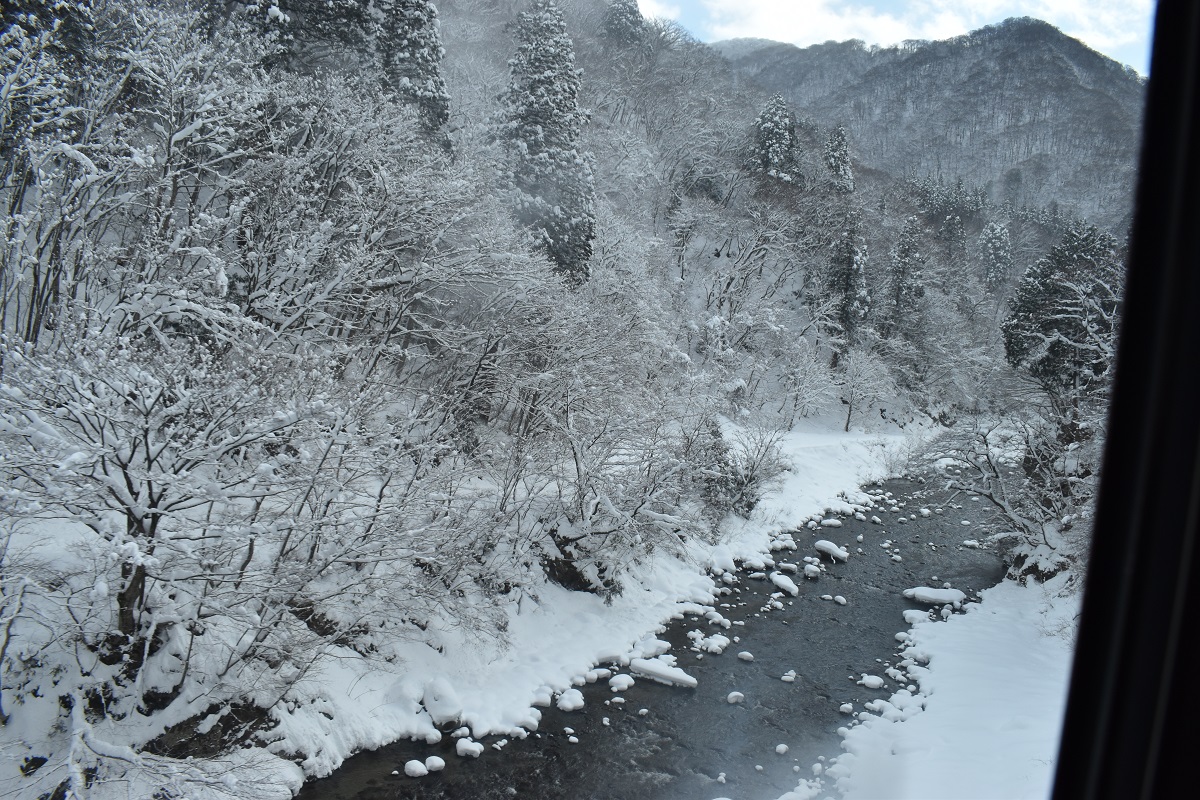
The Tadami Line, which connects Uonuma and Aizu, is famous for offering scenic views of remote areas from its train windows, but you can enjoy the scenery even just up to Echigo-Suhara Station, where the Meguro Residence is located.     We crossed several rivers, and the river water was a deep blue, like the color of melted glaciers.    While Echigo-Suhara Station has a very atmospheric exterior, be aware that it is not heated in the middle of winter.


tadami line in snow (10)
Go back to itinerary