Why does Niigata have such huge wooden houses—especially considering they have to withstand heavy, wet snow in winter? Furthermore, the gardens surrounding the residences possess a blend of elegance and grandeur that rivals—or even surpasses—those of Kyoto. A prime example of this is the Watanabe Residence in Sekikawa Village.
watanabe house (14)
watanabe house (11)
watanabe house (13) dragon on th ceiling
watanabe house (16) garden left side
watanabe house (17) garden center
watanabe house (18) garden right side
The first head of the family served as a district magistrate for the Murakami Domain—handling duties such as tax collection, the administration of the peasantry, judicial and police functions, and local inspections. After retiring and moving to the current location, he amassed a fortune by launching businesses in sectors such as sake brewing and finance; he also provided financial assistance to the neighboring Yonezawa Domain and enjoyed a close relationship with Uesugi Yōzan. It is said that at its peak, forty servants lived on the premises. It also posses six large storehouses. What is truly astonishing is the vast open space that unfolds upon entering: a wide earthen-floored area where carts could roll straight in from the street, and a raised wooden-floored hall from which cargo inspections could be conducted. It is vast enough to easily accommodate an entire gymnasium.
watanabe house (2) An earthen-floored area accessible directly by a vehicle’s cargo bed.
watanabe house (6) An earthen-floored area accessible directly by a vehicle’s cargo bed.
As for its exterior, the building features a roofing style known as *ishi-oki koba-buki*—designed to withstand the region’s harsh winters characterized by heavy snowfall and strong winds—in which cedar shingles are laid across the roof and weighted down by approximately 15,000 cobblestones.
watanabe house (23)
watanabe house (34) stones on the roof
watanabe house (27) Restoration work
The interior features beams exceeding 10 meters in length, constructed by interlocking cut ends without the use of nails. The repair methods employed during the major restoration work carried out in the Heisei era are reminiscent of a mechanical puzzle box. I highly recommend hiring an on-site guide to hear detailed explanations.
watanabe house (29)
watanabe house (3)
watanabe house (4) kitchen
watanabe house (5) A Carpenter’s Playfulness
watanabe house (7)
watanabe house (8) An honorable family crest
watanabe house (9) Signs of repair
watanabe house (28) Restoration work
watanabe house (15) look like Floating ceiling
watanabe house (19) Solid wood ceiling
watanabe house (20) Nail cover
watanabe house (21) Nail cover
watanabe house (10) Sword marks from the Boshin War
watanabe house (26)foldable ladder
Now, the reason I took an interest in the Watanabe Residence is that, about twenty years ago—and the show has been rebroadcast several times since—NHK aireda drama titled *Kura* (The Storehouse), and this location served as the filming site. While the word “kura” (storehouse) might evoke an image of confinement, the story depicts a protagonist—the daughter and heir of a wealthy landowner—who loses her sight to illness in childhood. Amidst a family tragedy where the landowner fails to produce a male heir and sons born to his concubines die one after another, she grows into a strong, resilient woman. Defying the conventions of the era, she becomes a female *kuramoto* (sake brewery owner), effectively breaking free from the confines of the storehouse. It is deeply moving to realize that this is the actual filming location—the very place where that breathtaking, vast space seen on the program exists.
Since the era of the Murakami Domain in the Edo period, salmon resource management has been practiced with a focus on the fish’s homing behavior. Salmon were also utilized as preserved food and reportedly helped support the domain’s finances. Consequently, there is a culture of fully enjoying the entire salmon, leaving no part to waste. At the long-established shop “Kikkawa,” various parts of the fish are prepared and sold; additionally, at their separate restaurant, lunches can savor a full-course salmon mealwhile learning about the different preparation methods.
salmon house and dishes (8) shop
salmon house and dishes (1)
salmon house and dishes (2)
salmon house and dishes (3)
salmon house and dishes (7)
salmon house and dishes (5)
It is surprising to discover such a wide variety of ways to enjoy salmon—a fish that, until now, I had only ever seen served as a slice grilled salmon right in the center of a traditional ryokan(Japaese inn) breakfast tray.
Located at the northern edge of Niigata Prefecture, Murakami City is cut off from neighboring Yamagata Prefecture by steep coastal mountains; consequently, its townscape retains a strong atmosphere of the Edo period, featuring merchant houses and samurai residences from its days as a castle town. The “Black Wall Street” along Anzen-koji Lane is a particularly charming place for a stroll—an activity best enjoyed after savoring the local salmon cuisine.
murakami city walking (1)
murakami city walking (2)
murakami city walking (3)
murakami city walking (4)
murakami city walking (5)
murakami city walking (6)
murakami city walking (7)
murakami city walking (8)
murakami city walking (9)
murakami city walking (10)
murakami city walking (11)
murakami city walking (12)
murakami city walking (13)
murakami city walking
In May, local merchants, temples, and private households open their prized gardens—nurtured with great care—to the public free of charge. These are not merely displays of plants left to grow wild; the very fact that these gardens are open for others to view implies a significant investment of time, effort, and money in their maintenance. City dwellers who grow plants only in pots likely cannot fully appreciate the magnitude of that undertaking.
Fusai-ji Temple is located more or less than a ten-minute drive north of downtown Murakami. A magnificent garden has been created by incorporating the steep slope behind the temple grounds. While there is a special period in May when the garden is fully open to the public, it remains accessible year-round.
fusaiji temple (1) entrance
fusaiji temple (2)
fusaiji temple (15)
fusaiji temple (3)
fusaiji temple (8)
fusaiji temple (13)
fusaiji temple (10)
fusaiji temple (4) There’s a frog somewhere
fusaiji temple (14)
Panoramic View of garden
fusaiji temple (5) left
fusaiji temple (6) center
fusaiji temple (7) right
Visitors can also hike up the hill behind the temple, which offers a splendid view of the surrounding rural landscape.
fusaiji temple (12)
fusaiji temple (9)
fusaiji temple (11)
No specific fee is set on the entrance, so please offer a donation based on what you feel is appropriate. I consider maintaining this garden to be a form of spiritual practice, in a sense.
Many municipalities across Japan organize “Fox Wedding Processions” as tourist attractions—recruiting a bride and groom to reenact this traditional supernatural phenomenon—and claim to be the original home of the custom. Among them, the Fox Wedding in Tsugawa is the oldest, with roots dating back to classical literature.
These eerie phenomena fall broadly into two categories: “countless mysterious lights” that could easily be mistaken for a swarm of paper lanterns, and “sunshowers”—rain falling while the sun is shining. Both types are associated with foxes—creatures said to possess the power to bewitch humans—but the phenomenon in Tsugawa belongs to the former category; it is said that mysterious lights appear at night on Mt. Kirin, located on the opposite bank of the Agano River, which flows beside the town. The event, which draws large crowds, takes place over a weekend in June and continues into the night. During the weekend, a steam locomotive runs along the line connecting to Aizu, located in the upper reaches of the Agano River.
tsugawa (4)kirin-zan
tsugawa (1) Iron bridge
The reason there are so many shops in this town specializing in fermented foods lies in Tsugawa’s geographical location. During the Edo period, the primary mode of transport involved *Kitamae-bune* (merchant ships) that navigated the relatively calm Sea of Japan coast rather than the Pacific side.
The Agano River flows wide and calm as far as Tsugawa, making it navigable for transporting materials; at this point, goods were transferred to horses for delivery to or shipment out of Aizu. The combination of seafood and salt brought from Niigata and rice arriving from Aizu gave rise to the production of *koji*-based foods in Tsugawa. The miso purchased at Yamazaki Koji-ya lacks any harshness—offering instead a natural sweetness—and transcends the ordinary concept of miso.
tsugawa (2) malt shop
This area is also said to be the birthplace of the *gangi*—wide, arcade-like eaves extending from shopfronts over the street—which were created in snow-prone Niigata to allow people to move about on snow-covered roads. Isabella Bird, who traveled through Japan’s remote interior during the early Meiji era, also noted their existence in her travelogue.
She reportedly described the Agano River—which widens significantly starting at Tsugawa—as resembling the Rhine. Perhaps she likened the sheer cliffs of Mount Kirin in Tsugawa to the Lorelei Rock; then again, one might easily sail right past the actual Lorelei Rock without even noticing it, were it not for the announcements made on board. Indeed, so many tourists look around restlessly when the announcement is made. The Lorelei Rock is counted among the world’s “three major disappointments“; the other two include the Little Mermaid statue in Copenhagen—where an industrial zone is visible on the opposite shore—and the Manneken Pis in Brussels, which, despite being right next to the central Grand Place, is so small that one might easily walk right past it without noticing. If the Manneken Pis were huge, it would just look like an adult urinating while standing, so perhaps it couldn’t be helped.
Detour 1 (Huge ceder)
Near the town of Tsugawa stands the Shogun Sugi, a cedar certified by the Ministry of the Environment as the largest in Japan—surpassing even the famous Jomon Sugi of Yakushima. Its trunk circumference is said to be approximately 20 meters, though it is unclear exactly where that measurement is taken. On the other hand, people cheat on where they measure to make their waists look slimmer. Although the main trunk has fallen, multiple branched trunks surrounding it rise up together, towering high toward the sky. With an estimated age of 1,400 years, it dates back to the time when Prince Shotoku was alive. Incidentally, the name “Shogun” (General) is derived from the military commander who subjugated the Tohoku region during the Heian period.
tsugawa (6)
tsugawa (5)the biggest cedar
Detour 2 (Roof tiles)
While tourist destinations showcasing pottery-producing regions can be found all over Japan, it is rare to find a place like Aga City that promotes factories manufacturing roof tiles as a tourism asset. These factories are clustered where the Agano River emerges onto the plains, forming a walking path known as “Kawara Road” (Tile Road). While there are facilities like a bus stop house and restrooms made entirely of roof tiles, as well as a cafeteria featuring tile-based plates, the display that allows visitors to take photos of themselves appearing to sit atop a tiled roof is sure to be a hit on Instagram. However, since roof tiles aren’t exactly the sort of thing people buy as souvenirs, a bit of creative ingenuity is required.
roof tiles (1)walking on the top
roof tiles (2)
Because the region experiences heavy snowfall, the roof tiles used there must offer excellent thermal insulation and cold resistance; made from iron-rich clay, they fire into a distinctive lead-gray color. In recent years, however, modern Japanese homes have shifted toward lighter structural materials to reduce construction costs, leading to a move away from traditional tiles in favor of slate roofing—making beautiful tiled roofs an increasingly rare sight in urban areas. A factory belonging to Yasuda Yogurt—famous for its dairy products—is located right next to the tile factory.
Despite being located in an area with such heavy snowfall, the building is a three-story wooden structure and itself Nationally Registered Tangible Cultural Property, so the masterful skills of the carpenters remain in many places. It is a long-established inn featuring a radon hot spring—a rarity even on a national scale. Breathe in the radon-rich air and revitalize yourself. The meals are delicious, too, featuring primarily local ingredients.
seiko-kan (8)
seiko-kan (3)
seiko-kan (2) An alcove featuring carefully selected premium timber
This town is home to one of Japan’s three great iris gardens and features castle ruins at its center, with the town itself laid out in concentric circles around them; as for the feudal lord’s garden—Shimizu-en—it struck me as familiar, and indeed, it bears a striking resemblance to Kyoto’s Koke-dera (Saiho-ji). Whether the town’s promotional efforts were lacking or I simply failed to spot them myself, a little research revealed that there were plenty of other highlights to see.
shibata town walking (2)
shibata town walking (1)
shimizu-en (8)
shimizu-en (1)
shimizu-en (2)
shimizu-en (15)
shimizu-en (3)
shimizu-en (4)
shimizu-en (5)
shimizu-en (6)
shimizu-en (7)
shimizu-en (9)
shimizu-en (10)
shimizu-en (11)
shimizu-en (12)
shimizu-en (13)
shimizu-en (14)
Zoshunkaku, a building originally constructed in Tokyo’s Shitamachi (i.e.downtown) district by the prominent industrialist Kihachiro Okura—a native of this town—has been relocated here. Mr. Okura was the founder of numerous major corporations that endure to this day, including what is now known as Taisei Construction Corporation. This construction company was responsible for building a palace for Emperor Meiji; Zoshunkaku was constructed using the same techniques to serve as a state guest house for entertaining figures from the political and business worlds. It features a blend of Japanese and Western styles, yet the design of the second-story roof—reminiscent of a festival float—exudes a sense of grandeur. The interior is also exquisitely crafted, so captivating that one loses all track of time. Cakes and drinks are served inside. I made a special stop at the shop providing the same cakes—a long-established store near the castle called Yamanobe Confectionery—and found a wide array of options, particularly rolled cakes, which made choosing quite a dilemma.
zohshunkaku (1)
zohshunkaku (2)
zohshunkaku (3) Inlay work
zohshunkaku (4) The Dragon on the Ceiling
zohshunkaku (5)
zohshunkaku (6)
zohshunkaku (7) Floor tiles
zohshunkaku (8) Floor tiles
zohshunkaku (9)
zohshunkaku (10)
zohshunkaku (11)
Returning to the town, one finds an area where temples are clustered together—likely for defensive purposes—and a walking path has been laid out along the waterways that run through this section of town. Hokoji is a temple of historical significance housing the graves of the lords of the Shibata Domain; its main gate is remarkably imposing. The temple grounds feature a cloister-style layout typical of the Soto sect, allowing visitors to stroll freely.
shibata town walking (4)
shibata town walking (5)
shibata town walking (6)
shibata town walking (7)
shibata town walking (8)
shibata town walking (9)
shibata town walking (10)
Returning to the town, one finds an area where temples are clustered together—likely for defensive purposes—and a walking path has been laid out along the waterways that run through this section of town. Hokoji is a temple of historical significance housing the graves of the lords of the Shibata Domain; its main gate is remarkably imposing. The temple grounds feature a cloister-style layout typical of the Soto sect, allowing visitors to stroll freely.
My expectations for the town of Shibata were completely—and pleasantly—surpassed.
Yozan Park is a small hill in the middle of town, close to Seibu Chichibu Station, but if you’re not careful, you’ll be exhausted before you even reach your destination. ‘Yozan’ is written with the kanji for “sheep mountain,” and it is said that in the past, it was a place where sheep were extensively grazed, and there is still an area where sheep are kept today.
Yohzan Park (9) named after sheep
View point to watch the downtown of Chichibu
Yohzan Park (2)view point
Yohzan Park (3)view point
Yohzan Park (4)view point
Yohzan Park (5)view point
From this park, you can see Mount Bukō, a representative mountain of Chichibu, directly in front of you. The contrast between the cherry blossoms in the park and the moss phlox spreading across the slope in the foreground is beautiful.
Yohzan Park (1)Mt.Buko
Yohzan Park (8)
Yohzan Park (6)
Yohzan Park (7)
Yohzan Park (10)Moss phlox
Yohzan Park (11)Moss phlox
However, be careful not to take the wrong entrance to the park, as you’ll end up climbing an incredibly steep slope. The signs that guide you from the station appear one after another, seemingly luring you down this steep hill. While it’s true that the spectacular views of cherry blossoms and moss phlox are at the southern end of the park, I highly recommend taking the approach from the middle, climbing up from the direction of the city hall where the Chichibu Night Festival finale takes place, even though it may seem far away.
Correct access is as below.
Incorrect, challenging access is as below.
shortcut to Yozan Park
Speaking of which, Mount Bukō is a mountain made up of limestone blocks, and a considerable amount has been eroded from its summit, which has become a landmark. It is said that this limestone was used extensively in the cement used to construct buildings in Tokyo. The reason there’s limestone in this location is that, long ago, it was a coral reef island in the Pacific Ocean, which was carried on the Pacific Plate and, instead of being dragged down by the Eurasian Plate, emerged onto the surface. You can really feel the dynamics of the Earth’s crust movement.
Detour
I recommend Chaco, a retro-modern coffee shop, which is located halfway up the hill at the northern end of Yozan Park. They also serve lunch if you’ve missed your usual lunchtime meal. They brew each cup of delicious coffee to suit each customer’s taste preferences. It’s perfect to enjoy with a delicious cake. The garden is also decorated with flowers.
There are many temples with the same name, Hōzenji, throughout Japan, but the most famous is the Hōzenji in Osaka, which houses the Mizukake Fudo Myoo (Water-Pouring Fudo Myoo). Because worshippers all pour water on the statue with ladles, the statue of Fudo Myoo is covered in moss.
weeping cherry blossoms in Hozenji temple (7)
Now, this blog post is about Hozenji Temple in Chichibu. Weeping cherry blossoms bloom earlier than Somei Yoshino cherry blossoms, so I had given up on seeing them, thinking they would have already fallen. However, the station attendant at Ohanabatake Station on the Chichibu Railway gave a detailed announcement of the day’s highlights, and he said that the weeping cherry blossoms at Hozenji Temple were still beautiful, although slightly past their peak. Since he said he had seen it before going to work, I believed his words and walked 2.5 kilometers down Kita-Sakura Street, then continued walking silently towards Hozenji Temple.
weeping cherry blossoms in Hozenji temple (1)
weeping cherry blossoms in Hozenji temple (2)
weeping cherry blossoms in Hozenji temple (4)
weeping cherry blossoms in Hozenji temple (6)
weeping cherry blossoms in Hozenji temple (5)
weeping cherry blossoms in Hozenji temple (8)
Indeed, even from a distance, the vast cluster of weeping cherry trees looked like a small hill. If we had come a little earlier, we might have been able to see the weeping cherry trees in full bloom, their branches covered in blossoms, stretching up the cliff behind the temple, but the white weeping cherry trees covering the area around the temple were simply magnificent. They are said to be 100 years old.
Nagatoro, located a short distance downstream from the center of Chichibu, is famous for its boat trips down the rapids and is also renowned for its dense cherry blossoms. Incidentally, while boat trips down the river are great, I also recommend rafting in the middle of summer and jumping into the Arakawa River midway through. Now, even in areas with a high concentration of cherry blossoms, the cherry blossom areas are spread out over a wide area, so you’ll get tired of walking unless you narrow down your area based on information about when the blossoms are in full bloom.
I recommend the 2.5-kilometer-long row of cherry trees along Kita-Sakura(North Cherry Blossoms) Street, which starts from Nagatoro Station to the next station, Nogami. The tunnel of cherry blossoms stretches on and on, and when you try to take a picture of it, a car or motorcycle inevitably gets in the shot because it’s so long and unobstructed.
North cherry blossoms Street in Nagatoro (1)approach to Mt.Hoto
Heading west from Kagemori Station on the Chichibu Railway, you’ll find a series of temples along the line, each boasting magnificent weeping cherry trees. It’s a bit of a distance, but it’s a leisurely stroll along the country road, admiring the cherry blossoms planted here and there along the way. Incidentally, the Arakawa River, which flows through downtown Tokyo, runs along the railway line. Here, it carves a deep gorge.
Urayamaguchi Station (2)
Urayamaguchi Station (1)
Shofukuji Temple
weeping cherry blossoms in Shofukuji temple (1)
First, I started walking from Bushu-Hino Station. Although there were no signs, I climbed up beside a farmhouse and suddenly Shofuku-ji Temple appeared. The sight of the cherry blossoms adorning the temple gate, which you can see when you look up the stairs, is truly breathtaking. This spot is on a slight hill, so you can see the Chichibu Basin beyond the curtain of weeping cherry blossoms in front of you, with cherry blossoms visible everywhere. You can also see the Chichibu Railway, and you’ll probably even see the steam locomotives moving along, spewing black smoke.
weeping cherry blossoms in Shofukuji temple (3)
weeping cherry blossoms in Shofukuji temple (7)
weeping cherry blossoms in Shofukuji temple (8)
weeping cherry blossoms in Shofukuji temple (9)
weeping cherry blossoms in Shofukuji temple (10)
weeping cherry blossoms in Shofukuji temple (4)
weeping cherry blossoms in Shofukuji temple (6)
weeping cherry blossoms in Shofukuji temple (5)
Seiunj Temple and Wakajishi Shrine
weeping cherry blossoms in Seiunji temple (11)
Next, we head towards the weeping cherry tree forest at Seiunji Temple, which is often seen on posters. Along the way, we pass a shrine with a sumo wrestling ring. The weeping cherry trees at Seiunji Temple are simply breathtaking. If you climb the stairs of the adjacent Wakajishi Shrine and look down from above, you can enjoy an even more spectacular view of the weeping cherry forest. Incidentally, the protective statue at the entrance of this shrine is a wolf, not a guardian lion. Apparently, they light up the shrine at night during the cherry blossom festival, and the fact that there are stalls selling farming tools gives it a very rural festival feel.
weeping cherry blossoms (1)field of sumo wrestling
weeping cherry blossoms (2)
weeping cherry blossoms in Seiunji temple (1)
weeping cherry blossoms in Seiunji temple (3)
weeping cherry blossoms in Seiunji temple (4)
weeping cherry blossoms in Seiunji temple (5)
weeping cherry blossoms in Seiunji temple (6)
weeping cherry blossoms in Seiunji temple (7)
weeping cherry blossoms in Seiunji temple (8)
weeping cherry blossoms in Seiunji temple (9)Wolves instead of guardian lions
weeping cherry blossoms in Seiunji temple (10)
weeping cherry blossoms in Seiunji temple (12)
source: Chichibumovies
Chosenji Temple
weeping cherry blossoms in Chosenji temple (7)
Finally, we visit Chōsenji Temple, famous for the revival of a giant weeping cherry tree that had once declined in vitality. Weeping cherry trees bloom earlier than Somei Yoshino cherry trees, so the giant white weeping cherry tree here has already shed its blossoms, but the temple grounds are beautifully maintained. Furthermore, this temple is worth visiting this year because it is unveiling its hidden Buddha statue for the Year of the Horse. However, since the unveiling is taking place in the back of the temple hall, which is quite dark, it is very difficult to see the face of the Kannon statue, making it almost as if it were not unveiled at all.
weeping cherry blossoms in Chosenji temple (9)
weeping cherry blossoms in Chosenji temple (1)
weeping cherry blossoms in Chosenji temple (2)
weeping cherry blossoms in Chosenji temple (3)
weeping cherry blossoms in Chosenji temple (4)
weeping cherry blossoms in Chosenji temple (5)
weeping cherry blossoms in Chosenji temple (6)
weeping cherry blossoms in Chosenji temple (8)
From here, I headed towards Urayamaguchi Station, surrounded by cherry blossoms, and returned to my accommodation.
Along the Chichibu Railway line, especially around the stations, weeping cherry trees are densely packed. What’s more, they’re not lined up in an orderly fashion, but rather grow naturally, which is what makes them so appealing. These photos, featuring cherry blossoms alongside a quaint old train station, are a classic example of cherry blossom photography.
Urayamaguchi Station (3)
Urayamaguchi Station (6)
Urayamaguchi Station (7)
Moreover, since the steam locomotive runs on weekends from spring to autumn, it would be a shame not to take photos of the steam locomotive and cherry blossoms together. However, securing a good spot is crucial for taking these kinds of photos. But, Chichibu isn’t overly touristy, so even photography enthusiasts are generally calm, and finding a good spot is still a peaceful affair.
Bushu Hino Station (4)SL fans
Bushu Hino Station (2)
Bushu Hino Station (5)
Bushu Hino Station (6)
A train whistle echoes in the distance, letting us know it’s getting closer. Soon, the hissing sound of steam can be heard traveling along the tracks. If you choose a location with a slope, you can capture the sight of black smoke billowing around cherry blossoms. The steam locomotive seems to approach slowly, but once it’s in front of you, it suddenly speeds past.
Bushu Hino Station (9)
Bushu Hino Station (7)
Bushu Hino Station (8)
Bushu Hino Station (3)
Bushu Hino Station (1)
My usual favorite photo spot is around Bushu-Hino Station. There’s a small level crossing without barriers, and an automated voice warns you “Dangerous!” if you try to cross it, but people who don’t know about the automated voice system are startled by the voice and almost trip, so it’s hard to tell which is more dangerous.
Soba restaurant (1)
Soba restaurant (2)
Soba restaurant (3)
If you walk about 20 minutes uphill from this railroad crossing, you’ll find a popular soba restaurant that only serves 49 bowls a day. The owner apparently checks the quality of the soba for one bowl each day, but you can’t help but think, why not just make 51 bowls? A score of 80 points was posted inside the restaurant at that day. It was indeed delicious. Soba noodles are a living thing, so eat them all first before starting on the side dishes. Also, since it’s a mountain trail, don’t forget your bear bell. You have to risk your life to eat delicious food.
The area along the Tadami Line is one of the heaviest snowfall regions in Japan, and the snow is wet with a lot of moisture, so weak buildings will collapse. Therefore, in this region, ladders are already in place to allow people to climb onto the roofs and remove the large amounts of snow that have accumulated. It’s definitely not for Santa Claus. Also, the foundations of the houses are about the height of one story.
In this environment, the Meguro Residence, a thatched-roof house built over 200 years ago, still stands. Its thatched roof is more than twice as thick as a typical thatched roof, and a considerable number of thick pillars are installed inside to withstand heavy snowfall. The descendants of the Meguro family still exist today. At the time, they were positioned between the ruling magistrates and the village headmen who managed the farmers. They were known as “warimoto shoya” (super village headmen) and negotiated with the magistrates regarding the allocation of land tax, and were granted the right to have surnames and carry swords, effectively acting as the family in charge of local administration.
meguro house buried in snow
meguro house (2)Thick thatched roof
meguro house (3)
Even today, there is a large hearth in the center of the house where firewood is burning. Above the hearth hangs a large, flat structure called a “hidana,” which prevents sparks from flying and igniting the thatched roof. In case of fire, the chains hanging from it can be cut to cover the hearth. The phrase “staying awake all night” is often used, and it originates from the practice of servants watching over the hearth fire and protecting against thieves. Apparently, dozens of servants lived and worked in this house at the time.
meguro house (4)
meguro house (5)fire shelf
meguro house (8)
It’s impossible to imagine what it was like back then without listening to the guide’s explanation. I heard many interesting stories, such as how there are three Shinto altars, one of which is modeled after the main hall of Ise Grand Shrine; how, because people always pass through the same threshold as part of proper etiquette, the wood has become warped in that area due to the friction of their kimonos; and how, after the end of the samurai era, they built a power plant.
meguro house (9)
meguro house (6)
meguro house (7)
meguro house (10)
meguro house (11)
Detour(Sake Brewery)
sake brewery (4)Natural ice storage(left)
There’s a sake brewery that every visitor to the Meguro residence must stop by. It’s Tamagawa Brewery, which inherited the sake brewing license previously held by the Meguro family. They cover heavy winter snow with a special sheet to protect it from melting and age their sake at low temperatures throughout the year. After a quick tour of the brewery, I head straight for the tasting of the 10 different types of sake they offer.
sake brewery (1)
sake brewery (2)
sake brewery (3)
Detour(Tadami Railway)
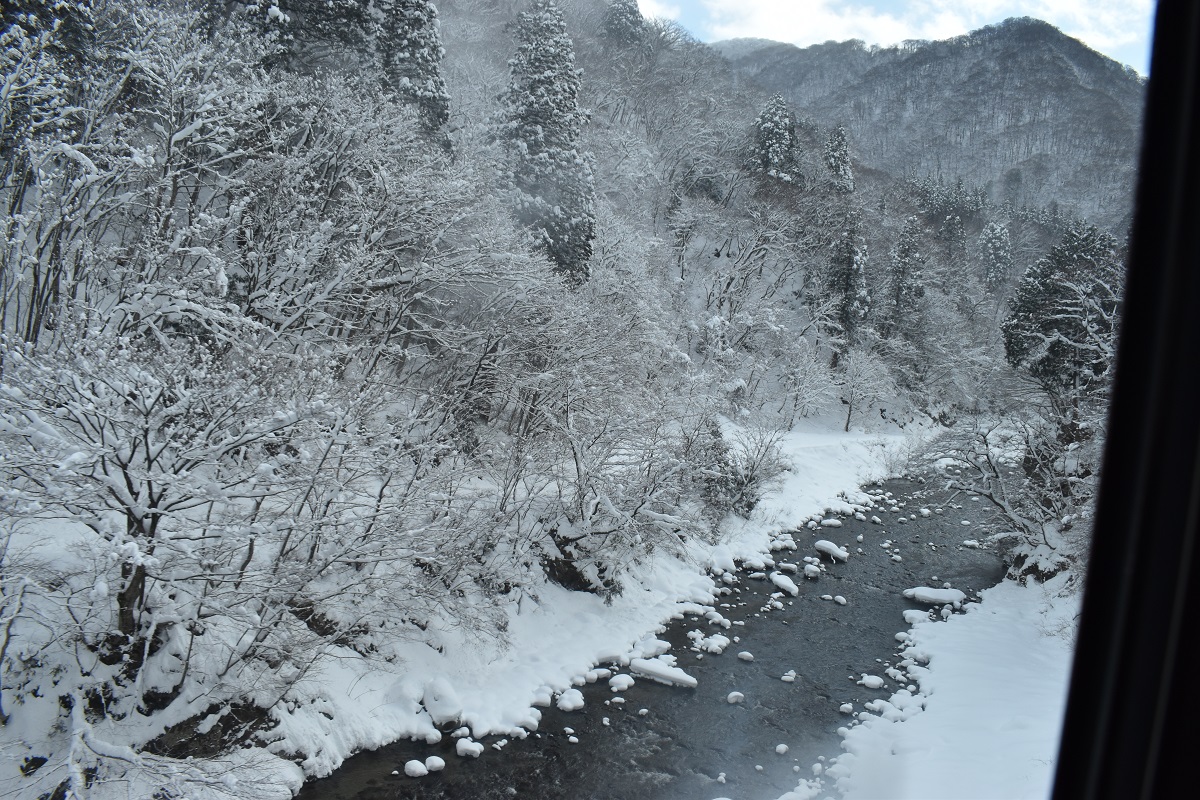
tadami line in snow (15)
The Tadami Line, which connects Uonuma and Aizu, is famous for offering scenic views of remote areas from its train windows, but you can enjoy the scenery even just up to Echigo-Suhara Station, where the Meguro Residence is located. We crossed several rivers, and the river water was a deep blue, like the color of melted glaciers. While Echigo-Suhara Station has a very atmospheric exterior, be aware that it is not heated in the middle of winter.