Who started calling him the Japanese Michelangelo?

saifuku temple (7)

He’s being promoted as Japan’s Michelangelo, but when someone suddenly mentions Michelangelo, it doesn’t immediately ring a bell.     He is Ishikawa Uncho.     When you search for Michelangelo’s representative works, the results are his sculpture of David, the Sistine Chapel’s Creation ceiling fresco, and the Last Judgment fresco.    While the 3D carvings on the transoms, carved from both sides, and the carvings covering the entire ceiling of the memorial hall certainly bear some resemblance to Michelangelo’s masterpieces, the more precise depictions evoke Ito Jakuchu, and the splashing waves suggest an homage to Katsushika Hokusai.

Eirinji Temple

In the central part of the temple’s main hall, a seductive celestial maiden playing a musical instrument is carved into the transom.     However, on the other side of the transom, which is only visible to the head priest, the naked back of the celestial maiden is carved.      You won’t find a temple like this anywhere else in Japan.    The transoms also feature carvings depicting stories and peacocks that devour the poisons of the world.     It would be fun to attend a boring Buddhist memorial service at a temple like this.

Saifukuji Temple

Beside the few steps leading up to the memorial hall stand Nioh statues that resemble David, but whose faces are undeniably anime-like.     And once you reach the top of the stairs, you are so overwhelmed by the gigantic sculptures covering the entire ceiling, which seem within reach, that you don’t even have time to look at the memorial tablets.


YoshidayThe scene depicts Zen Master Dogen, nearly attacked by a tiger, summoning a dragon with a thrown stick (this part somehow reminds me of Pokémon), with an eagle observing the scene, carp swimming upstream against a waterfall, and small birds flapping their wings on the cliff face.     However, various other animals are scattered among the sculptures, and the level of detail is so exquisite that you’ll want to lie down in the memorial hall and examine it closely.    You shouldn’t actually lie down on it.


There is also another sculpture, though uncolored, depicting a figure copying scriptures at a long table, but incorporating perspective.    Furthermore, the front of the memorial hall building is adorned with intricate carvings.     I was able to photograph these, but photography is prohibited inside.     For more details, please purchase the photo book.     Incidentally, the interior photos in this blog are from the tourist association’s brochure.

Detour

Yoshidaya's cream puffs
Yoshidaya’s cream puffs

Yoshidaya‘s “Cookie Choux” is popular for its freshly baked, crispy pastry and smooth, light custard cream filling.    In addition to Western-style sweets, they also have a wide selection of Japanese sweets.    Yoshidaya is located in the shopping street just before crossing the Uonogawa River, on the way from Echigo-Horinouchi Station to Eirinji Temple.


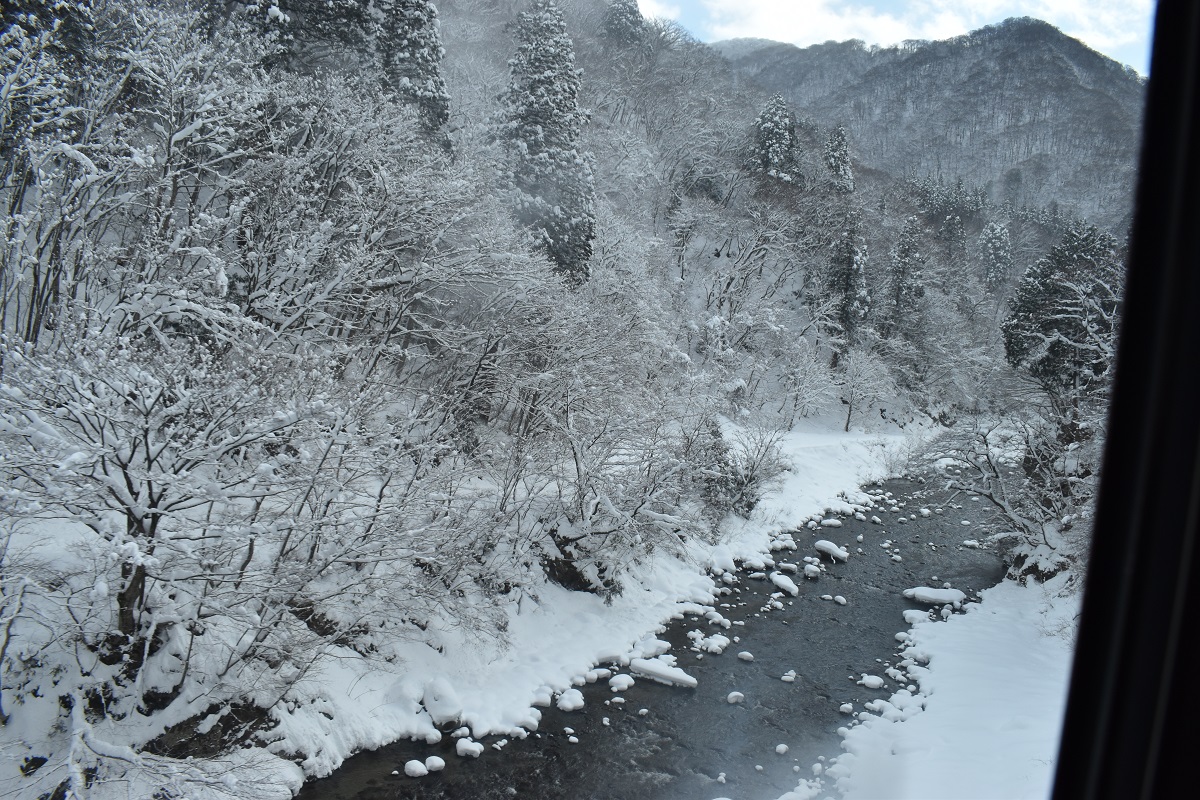
tadami line in snow (10)
Go back to itinerary

Torioi-Kannon Temple where asking for immediate death without suffering when you are dying

monkey hiding from eagle
torioi kannon
torioi kannon temple

Torioi-Kannon Temple is one component of Western Pure Land.
Since no one wants to suffer when they die, the ’Korori’ Kannon faith was born. People are fine(‘pin-pin’) just before they die, and when they die, they want to die lightly(‘korori’). In Japanese, this is called pin-pin korori.
You can listen to the fun story of the monk. However, although it is in Japanese.

There are famous sculptures you should not miss in this temple.  One of them is a monkey hiding from a eagle.  It is said to have been made by Hidari Jingoro, a famous sculptor of the Edo period. However, it seems that there are about 100 works in the whole country, and the authenticity is unknown.

tou no hetsuri shrine
Go back to itinerary

Western Pure Land, namely paradise after death

huge floor in kumano shrine
shingu kumano shrine

Western Pure Land, namely paradise after death in the direction where the sun sets, is where the Agano River flows out west from the Aizu Basin.

As I mentioned three types of Buddha statues, the latest type was ‘Amida’ who promises the happiness of the next life in an uneasy era when the plague spread and war began to break out here and there at Heian period end.  “The next life begins from next day” was connected to sun set and people has believed in paradise after death in the west.
That is Western Pure Land.

niouzou in kamiunai yakushi

On the other hand, it seems that the people of the Middle Ages had traveled quite far. The Aizu Lord regretted that money would drop in other areas, and set up 33 Kannon tours in his territory by connecting 33 Buddhist temples with the same history as Nara, accomplishment of it would promise happiness for the next life.


There are many places of faith in Western Pure Land in Aizu, but choose below.

gingyo 800 years old

Shingu-Kumano Shrine

800 years old Ginkgo and huge worship hall without walls


kamiunai yakushi temple

Kamiunai-Yakushi Temple
(prior reservation)

The same style of Buddha statue as in Shoujiji Temple.


eryuji temple
eryuji temple

Eryuji Temple

7m height Kannon(Buddha statue) carved in a standing tree with 30 statues including statues with wings like a christian angel statue.


Sake difficult to obtain

hiroki sake brewery
hiroki sake brewery

Faith and sake have always been linked.  Great sake exists in Western Pure Land.
‘Hiroki’ is my favorite sake.  Side dish is not needed and I enjoy it alone.


sake hiroki out of stock

“Even I can’t get it.”, said the worker in that brewery in Aizu Bange downtown.  I failed to get fantastic sake directly.


tou no hetsuri shrine
Go back to itinerary


Shoujyouji Temple with National treasure buddha statue comparable to Yakushiji Temple in Nara

shoujyouji temple main
shoujyouji temple gate

Temple size is now small but the meaning is comparable to Yakushiji Temple in Nara, where the main statue is Buddha giving medicine to people.
If I write without fear of misunderstanding, there are three types of Buddha statues: Buddha, the founder of enlightenment, pharmacist (Namely ‘Yakushi’ is a medicine master in literary in Japanese.) who cures the illness of this world, and Amida who promises the happiness of the next life.

bandai mountains from shoujyouji


Advance reservations* are required to view Yakushi Nyorai(Buddha statue), but it is a good opportunity to know that there was a similar Buddhist culture in the area away from Kyoto and Nara.
*)Local people take care of the temple by themselves.

Small Detour

nanukamachi street
nanukamachi street in aizu wakamatsu city

There are many tourist destinations in Aizu-Wakamatsu City, but this site is about the countryside, so I will omit it here.  I had a glance of historical street ‘Nanukamachi’ by chance passing through the city.


tou no hetsuri shrine
Go back to itinerary


Sasano Kannon with thatched roof like a helmet of battle is a symbol of faith

Sasano Kannon5

Sasano Kannon is one of the 33 Kannon pilgrimages in Okitama area, but it is especially admirable because the lord of the Yonezawa domain had visited it repeatedly. The roof is very large compared to the lower structure, and the sculptures under the eaves are rich and detailed.

Kannon aims to relieve people’s suffering by changing 33 forms and faces, so 33 Kannon pilgrimage routes had been established in various areas, and it is interesting that industries such as local specialty products are flourishing there.

In Sasano Kannon, lord Youzan Uesugi encouraged the hawk carving by only one engraving tool, and its technology has been passed down to the present day near the Kannon.
The hawk’s carvings made from the Enju tree, Japanese Pagoda tree, have a reddish exposed core that forms part of the design (see below left).    It is said that Enju is good for longevity and success in life because it is written in Kanji, Japanese character, that the life span extends.  Japanese people like these word games !

The famous saying* is displayed (see above right) because the store name is ‘Youzan’, which President Kennedy had respected.
 >Please read detail another post.

*)”If you try to do, it can be achieved, if you don’t, it will never be achieved. Achieving nothing is due to one’s own intention to not try.”

I found something valuable in this shop.    It’s a basket woven from mountain vines and sells for $3,000 to $4,000 per department store in Tokyo.    See for yourself how much is here.


Mountain Pass Station0
Go back to itinerary