
The area along the Tadami Line is one of the heaviest snowfall regions in Japan, and the snow is wet with a lot of moisture, so weak buildings will collapse. Therefore, in this region, ladders are already in place to allow people to climb onto the roofs and remove the large amounts of snow that have accumulated. It’s definitely not for Santa Claus. Also, the foundations of the houses are about the height of one story.
In this environment, the Meguro Residence, a thatched-roof house built over 200 years ago, still stands. Its thatched roof is more than twice as thick as a typical thatched roof, and a considerable number of thick pillars are installed inside to withstand heavy snowfall. The descendants of the Meguro family still exist today. At the time, they were positioned between the ruling magistrates and the village headmen who managed the farmers. They were known as “warimoto shoya” (super village headmen) and negotiated with the magistrates regarding the allocation of land tax, and were granted the right to have surnames and carry swords, effectively acting as the family in charge of local administration.


Even today, there is a large hearth in the center of the house where firewood is burning. Above the hearth hangs a large, flat structure called a “hidana,” which prevents sparks from flying and igniting the thatched roof. In case of fire, the chains hanging from it can be cut to cover the hearth. The phrase “staying awake all night” is often used, and it originates from the practice of servants watching over the hearth fire and protecting against thieves. Apparently, dozens of servants lived and worked in this house at the time.


It’s impossible to imagine what it was like back then without listening to the guide’s explanation. I heard many interesting stories, such as how there are three Shinto altars, one of which is modeled after the main hall of Ise Grand Shrine; how, because people always pass through the same threshold as part of proper etiquette, the wood has become warped in that area due to the friction of their kimonos; and how, after the end of the samurai era, they built a power plant.


Detour(Sake Brewery)

There’s a sake brewery that every visitor to the Meguro residence must stop by. It’s Tamagawa Brewery, which inherited the sake brewing license previously held by the Meguro family. They cover heavy winter snow with a special sheet to protect it from melting and age their sake at low temperatures throughout the year. After a quick tour of the brewery, I head straight for the tasting of the 10 different types of sake they offer.


Detour(Tadami Railway)

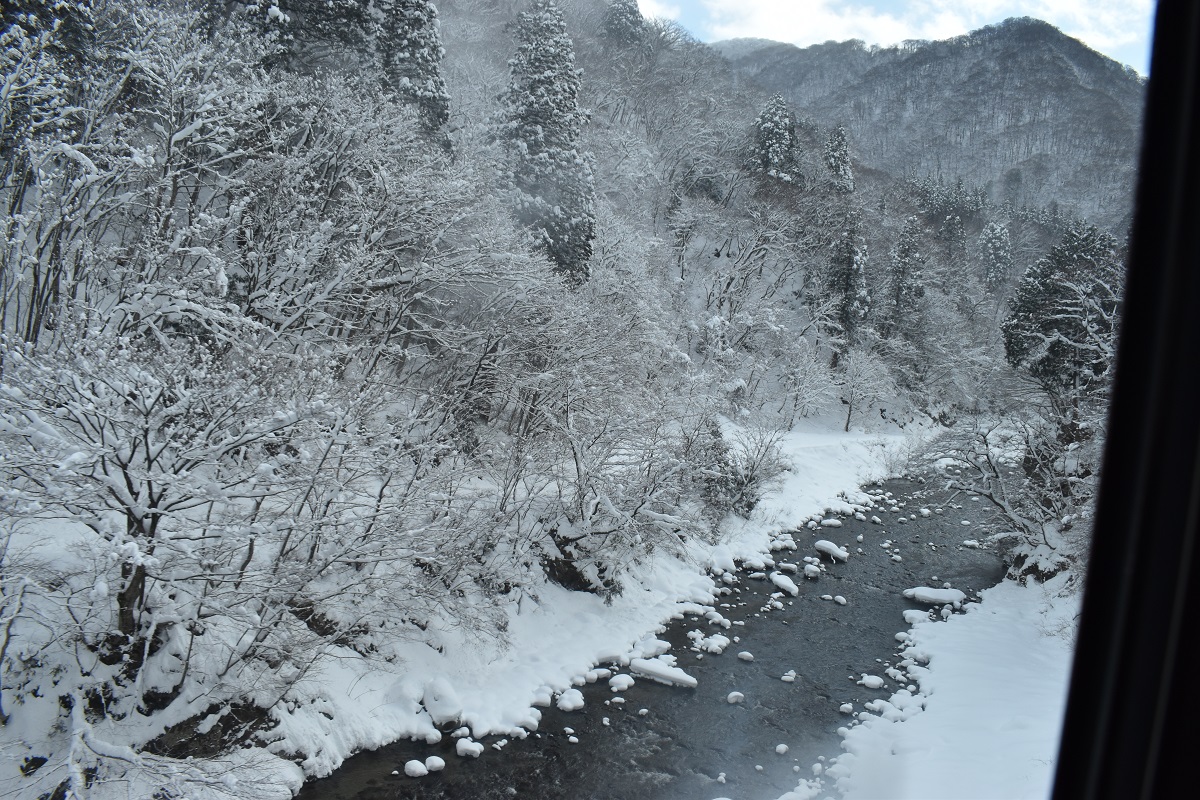
The Tadami Line, which connects Uonuma and Aizu, is famous for offering scenic views of remote areas from its train windows, but you can enjoy the scenery even just up to Echigo-Suhara Station, where the Meguro Residence is located. We crossed several rivers, and the river water was a deep blue, like the color of melted glaciers. While Echigo-Suhara Station has a very atmospheric exterior, be aware that it is not heated in the middle of winter.


