
Introduction
What exactly is a *gata* (lagoon) in Niigata? I found an old map at the inn where I stayed, showing that most of the Niigata Plain was once underwater. Sea reclamation left lagoons as remnants of lakes and marshes, a feat that required effort to expand arable land. Today, they serve as excellent spots for birdwatching.


True to its reputation as a major rice-producing region, beautiful rice paddies stretch out endlessly wherever you go. While Niigata City has served as the administrative hub since the Meiji era, historically, the name “Echigo” was synonymous with Uesugi Kenshin—whose power base was centered in Joetsu City, located at the far western edge of the prefecture. This trip takes me to the Ka-etsu region—located east or north of Niigata City—where I will visit the territories of the Shibata and Murakami domains, both of which date back to the Edo period.

Once you return to Niigata City, try going up to the observation deck on the top floor of Toki Messe, a high-rise building next to the port. You can enjoy a free 360-degree view of the Niigata Plain. After leaving Toki Messe, why not have some sushi at “Minato no Marche Pia Bandai,” which features a food court? The prices are comparable to standard conveyor-belt sushi restaurants, but the quality is so high that you simply won’t find the same level at famous nationwide sushi chains.


Detail
1st day (Shibata domain)
I let my guard down with Shibata at first, thinking there was nothing worth seeing

It takes just over half an hour to reach Shibata Station from Niigata Station. Considering the redevelopment work around the center of Niigata, the train would undoubtedly get you there faster. The sightseeing spots—which I discovered later—are concentrated around the station, making it convenient for tourism. The lunch at Nagashima, a traditional Japanese restaurant in front of the station, is delicious and offers great value for money.

The Fox’s Wedding

There are three railway lines connecting Niigata Prefecture to Fukushima and Yamagata Prefectures. Having overcome numerous natural disasters, two of them remain in operation today. One of these is the Ban-etsu West Line, which connects Niitsu—home to the Railway Museum—to Kitakata in the Aizu region via Tsugawa. I highly recommend trying this route on weekends during the peak season, when steam locomotives are in operation.
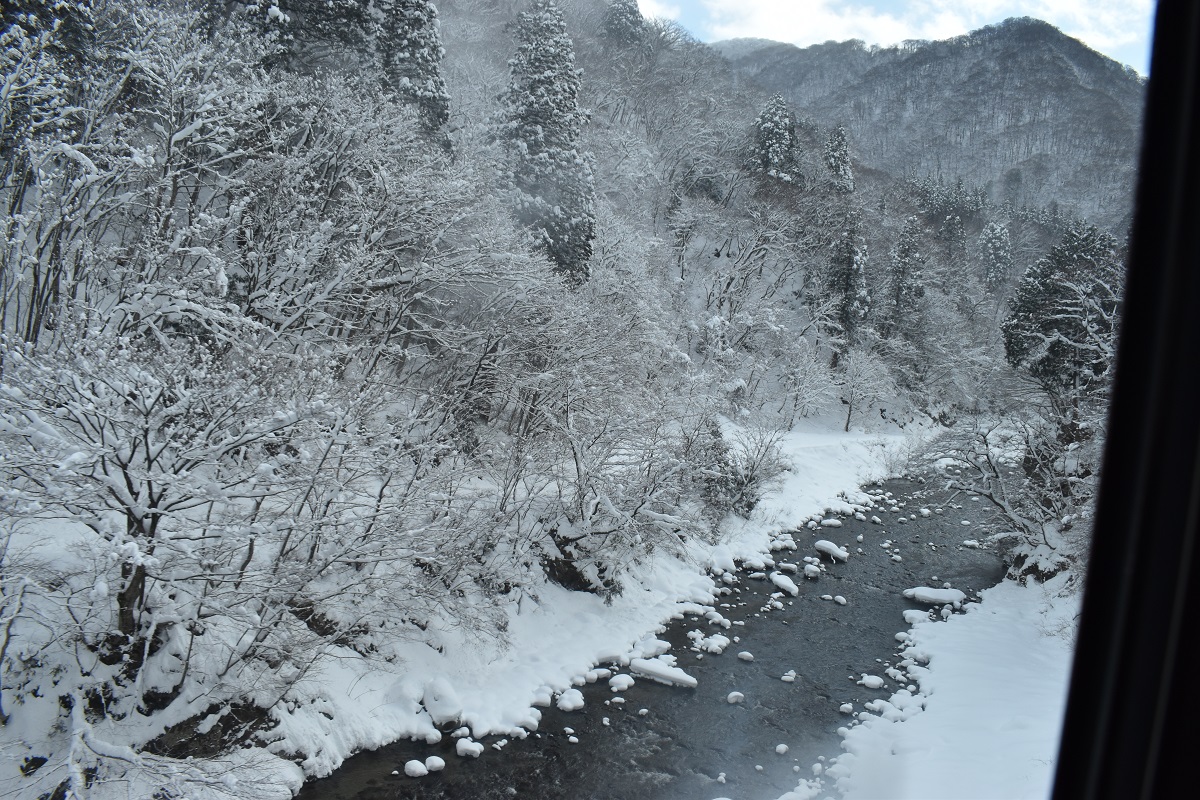
It takes about 100 minutes to get to Tsugawa from Niigata Station, including a transfer at Niitsu. The Agano River gorge along the railway line extending to Aizu is beautiful.

2nd day (Murakami domain)
The wisdom of the Murakami Domain in managing the salmon returning to the river

It takes just over 30 minutes to reach Murakami Station from Shibata Station, yet the town center is a long way from the station itself. This serves as evidence of the old town’s well-preserved, traditional atmosphere—suggesting that it was likely impossible to build the station within the town proper. The old town looks just like a movie set, making one feel as though they have stepped back in time to the Edo period.


It is a place to savor a full-course meal that utilizes every part of the salmon, followed by a leisurely stroll. As winter approaches, salted salmon is hung from the eaves of shops to cure in the cold wind; while scenes of dried persimmons hanging from eaves are common, the sight of salmon hanging there must be a truly striking spectacle.
A massive wooden house built to withstand the snow

Due to disaster damage, the railway line connecting Niigata to Yamagata through Sekikawa Village is currently severed; consequently, the village is accessible via substitute bus service or by car—a drive of approximately 30 minutes from the city center of Murakami. The Watanabe Residence fronts the Yonezawa Kaido—the road leading to Yamagata—and the building spans nearly 40 meters in width; it bears no resemblance whatsoever to an ordinary home.

Please contact us through ‘Contact us‘ form if you have any questions.